
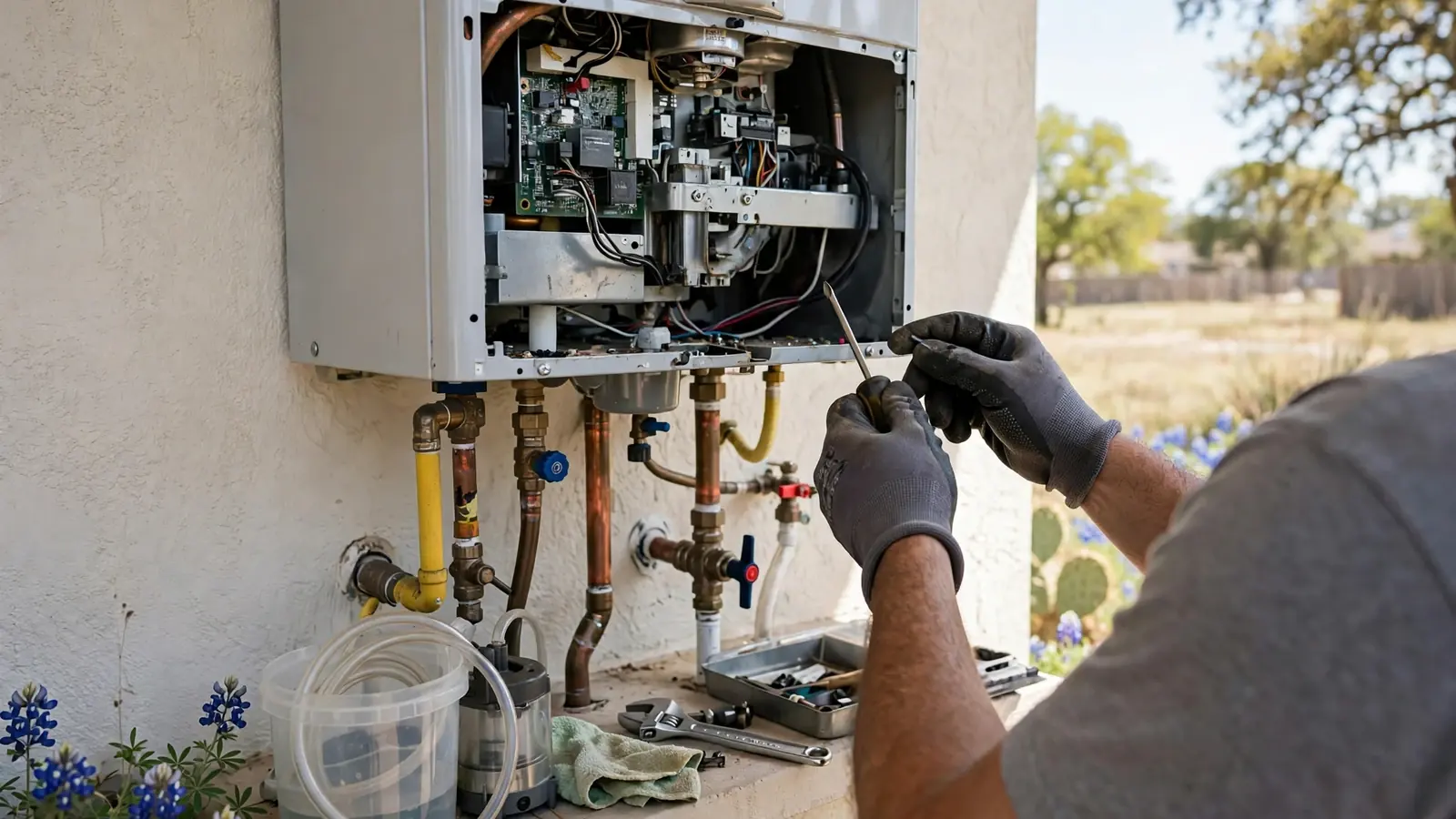
Amperage is the question that decides whether an electric tankless water heater fits your house in Orem, UT or turns into an electrical project. Unlike a tank heater that heats slowly on a modest circuit, an on-demand unit heats water as it flows and pulls a big load all at once.
This guide explains how to read a nameplate, why the number is bigger than most people expect, and which parts of the decision belong to an electrician and which belong to a plumber. It does not replace a load calculation on your own panel.
Why an electric tankless heater draws so much current.
Heating water quickly takes a lot of energy. A storage tank can spend an hour warming a full tank on a small element. A tankless unit has to lift the temperature of moving water in a few seconds, so its heating elements are rated in kilowatts, often several times larger than a tank element.
Current follows from a simple relationship. Amps equal watts divided by volts. As arithmetic only, a unit rated at 24 kilowatts on a 240 volt supply works out to about 100 amps when every element is on. Your unit will have different numbers, which is why the nameplate matters more than any rule of thumb.
To see the range, run the same arithmetic on other sizes. A 12 kilowatt unit on 240 volts works out to about 50 amps and a 36 kilowatt unit to about 150 amps. Neither figure is a circuit size. Manufacturers usually specify breaker and wire sizes with margin above the raw draw, often split across more than one breaker, which is why the manual overrides your arithmetic.
How to read the nameplate on the actual unit.
Every electric tankless heater carries a rating label, and manufacturers also publish the same figures in the installation manual. Use the exact model you plan to buy.
Find the voltage
Look for 240 volts on most whole-house models. Smaller point-of-use units may use other voltages and are a different class of product.
Read the wattage or kilowatts
This is the total element rating. Some units list several elements, so add them up as the label directs.
Find the stated amps
The label or manual often lists maximum amps and the number of circuits or breakers needed. Use the maker's figure, not your own estimate.
Note the wire and breaker sizes
The manual specifies the wire gauge and breaker the maker expects. A licensed electrician confirms what your installation and local rules require.
Compare to the panel
Ask an electrician for a load calculation that adds your heater to everything else the panel already carries.
Orem, UT: older panels, permits, and winter water
Orem grew from 8,351 residents in 1950 to 52,399 in 1980, and the city counted 31,591 housing units in 2020. A large share of those homes was built in that postwar window, and many still have the electrical service they started with. That does not mean any particular panel is too small, but it is a good reason to ask for a load calculation instead of assuming.
Orem's published permit page says a permit is needed for anyone who causes electrical, plumbing, heating or air conditioning work to be done, with exceptions on a separate page. Permit rules vary by job, so ask the Orem Building Safety Division before you commit. A tankless swap touches both electrical and plumbing work, so confirm which permits apply.
Incoming water is much colder in winter than in summer. A heater sized for summer inlet temperature may underperform in January, so ask an installer to size to the cold season. Vineyard and Lindon homes face the same winter inlet issue.
Electric, gas, and hybrid: how the load compares.
The fuel decides where the big demand lands. This table sorts the common setups, not the models, so use it to ask better questions.
| Setup | Where the big demand lands | What to confirm before buying. |
|---|---|---|
| Whole-house electric tankless | Electrical panel and service capacity | Nameplate amps, breaker count, panel spare capacity. |
| Gas tankless | Gas supply line and venting | Gas line size, vent route, condensate drain. |
| Electric tank (storage) | One moderate dedicated circuit | Existing breaker and wire already serve the tank. |
| Point-of-use electric | One small fixture, short run | Whether it can deliver enough flow for a shower. |
| Heat pump storage tank | Moderate circuit, plus airflow around the tank | Clearance and condensate path. |
A gas tankless heater still needs a small electrical supply for its controls and fan, but it does not carry the large element load.
Call to ask what the water-side work on a tankless install includes.
Call (385) 488-1892.What the panel conversation should cover.
A licensed electrician looks at the main breaker rating, the spare spaces in the panel and the other big loads. Those include an electric range, dryer, air conditioner or car charger. The electrician also measures the wire run to the heater location. Those details decide whether the existing service can carry the new heater or whether the panel or service needs an upgrade.
That is outside what a plumber does. A plumber handles the water side: sizing the flow, the shutoffs, the pipe connections, and the finished hookup. When you plan a switch, the usual route is to ask your plumber for the water-side scope on a tankless water heater and have an electrician put the electrical scope in writing.
Electrical work for the unit follows the National Electrical Code (NEC) as adopted by the state, and the electrician and the inspector apply it to your panel. This guide is not a substitute for that review.
Limits of this guide.
This page gives general electrical relationships, not code advice. It does not cite breaker, wire, or clearance requirements, because those depend on the exact unit, the installation, and the rules in force where you live. Do not use any figure here to size a circuit.
If a heater is already installed and a breaker keeps tripping, shut the power off at the panel only if the panel is dry and you can reach it safely, and have an electrician look at it. Water near electrical equipment is a hazard, so keep people away from wet areas.
How flow rate and incoming water temperature change the load.
The more hot water you want at once, and the colder the water coming in, the harder the unit works. A heater that handles one shower can struggle when a second shower and the dishwasher start. Manufacturers publish flow rates at a given temperature rise, and those tables show why winter performance is lower than summer performance on the same unit.
If your household runs several fixtures at the same time, ask the installer how the plan handles that. Some homes end up with two smaller units, a bigger one, or a different type of heater altogether. A good water heater installation quote names the flow rate the unit is expected to meet.
Questions to settle before you order a unit.
- What is the exact model, and what amps and breaker count does its manual list?
- How much spare capacity does the main panel have after the load calculation?
- Where will the unit mount, and how long is the wire run from the panel?
- Which fixtures will run at once, and what flow does the unit deliver at winter inlet temperature?
- Who is responsible for the permit paperwork on the electrical and plumbing sides?
- Is the existing gas or electric tank still in place, and what happens to its circuit?
Common questions
It depends on the model. Many draw a very large dedicated load, which is why you read the nameplate on the actual unit and have an electrician check the panel. The kilowatts on the label divided by the volts gives the amps.
Not automatically. The panel needs spare capacity and the service has to carry the added load alongside your other appliances. A licensed electrician makes that call after a load calculation.
It shifts the demand to the gas line and the vent, which have their own limits. A gas unit also needs a small electrical supply for its controls. A gas odor at any time means you should get everyone outside, then phone the gas utility or 911 before anything else.
Orem's city page says a permit is needed for work that causes plumbing or electrical work to be done, with listed exceptions. Permit rules vary by job, so ask the Orem Building Safety Division and have the installer confirm who files.
It can. Incoming water is colder in winter, so the same unit delivers less hot water per minute than it does in summer. Ask the installer to size to the cold season and to name the expected flow.
Sources and references
- Ohm's law relationship (amps = watts / volts), used as arithmetic illustration only, no unit-specific figures or code requirements cited.
- Census counts and 2020 housing units for Orem (U.S. Decennial Census as tabulated on Wikipedia).
- City of Orem Building Safety Division permit page, orem.org.