
Published by Orem 24/7 Plumbing, a dispatch service in Orem, UT. Page published October 23, 2026.
Water on the floor around a tank is urgent, and Orem 24/7 Plumbing keeps licensed and insured plumbers on dispatch 24/7. Until someone arrives, close the cold supply valve above the heater, set a gas unit to pilot or off, and keep everyone out of the wet area. For an electric unit, use the breaker only if the panel is dry and you can reach it safely. Smell gas? Leave and call the gas utility or 911.
Water heater repair in Orem, UT means finding the one failed part behind a leak or a cold shower and fixing it, so the tank can keep working. That works when the steel shell is sound. When the shell itself has rusted through, no repair holds, and the decision moves to replacing the whole unit. A technician can usually tell which situation you have within the first few minutes of looking at where the water is coming from.
Signs a water heater needs a plumber today.
Some symptoms can wait for a morning appointment. Others get worse every hour. This list helps you sort which is which before you call.
- Water pooled at the base of the tank, especially if it keeps coming back after you wipe it up.
- Drips or a wet stain at the pipe fittings on top, where the hot and cold lines screw into the tank.
- Water running from the discharge pipe beside the temperature and pressure relief valve.
- Rust-colored water from hot taps only, which points to the inside of the tank and not the house piping.
- Rumbling, popping or knocking from the tank when it heats, a sign of sediment baked onto the bottom.
- No hot water at all, or hot water that runs out in a couple of minutes.
- Soot, a yellow burner flame, or a pilot that will not stay lit on a gas unit.
- A scorched smell, a tripped breaker, or an error code on the control panel of an electric or heat pump unit.
When a leaking water heater is an emergency.
A tank that is steadily leaking is an emergency because a typical 40 or 50 gallon tank can empty onto a finished basement floor in one night. If water is actively running, shut the cold supply, open a hot tap somewhere upstairs to relieve pressure, and call. Dispatch runs at night, on weekends and on holidays, and a same-day appointment is offered when the schedule allows.
Do not wait for a slow drip to prove itself. Water that sits under a tank soaks drywall, carpet pad and the bottom plate of a wall, and the damage often shows up later as mold. If the leak is small, dry and only at a fitting, it is still worth a call that day, but it is not the same kind of rush as water spreading across the floor.
Where a tank leaks, and what each location tells a plumber.
A leak at the base can come from three places, and only one of them is fatal for the heater. The drain valve at the bottom may be seeping and can be replaced or capped. A leaking element gasket on an electric unit, or a bad burner access seal on a gas one, can sometimes be redone. Water that comes from the bottom of the shell itself means the tank has corroded through, and the fix is a new heater.
Fitting leaks are the best news. A weeping union, a cracked flex connector or a failed dielectric nipple at the top of the tank is a small parts job.
The relief valve is different. A valve that drips once in a while can be worn, but a valve that runs often is reporting something about pressure or temperature. A plumber checks the thermostat, thermal expansion on a closed system and incoming water pressure before changing the valve, because a new one will start dripping again if the cause stays.
Tank corrosion is where most old heaters end. Inside the shell, a sacrificial anode rod gives itself up so the steel does not rust. Once the rod is spent, the lining pits. Replacing a rod in a sound tank can extend its life, but a heater that already weeps from the shell cannot be saved.
If the source of wetness is unclear, a plumber may trace nearby piping through leak detection to make sure the water really comes from the tank.
If your tank is leaking or the water has gone cold, call (385) 488-1892 and a dispatcher will start from the symptom.
Call (385) 488-1892Gas, electric and heat pump heaters fail in different ways.
Gas heaters rely on a thermocouple, a gas control valve, a burner assembly and a flue that carries exhaust out of the house. A pilot that keeps going out usually points to a worn thermocouple or a dirty pilot tube. A heater that lights but heats slowly may have a sooty burner or a partly blocked vent. Any sign of backdrafting, such as a hot draft hood or soot around the top, needs attention before the heater runs again.
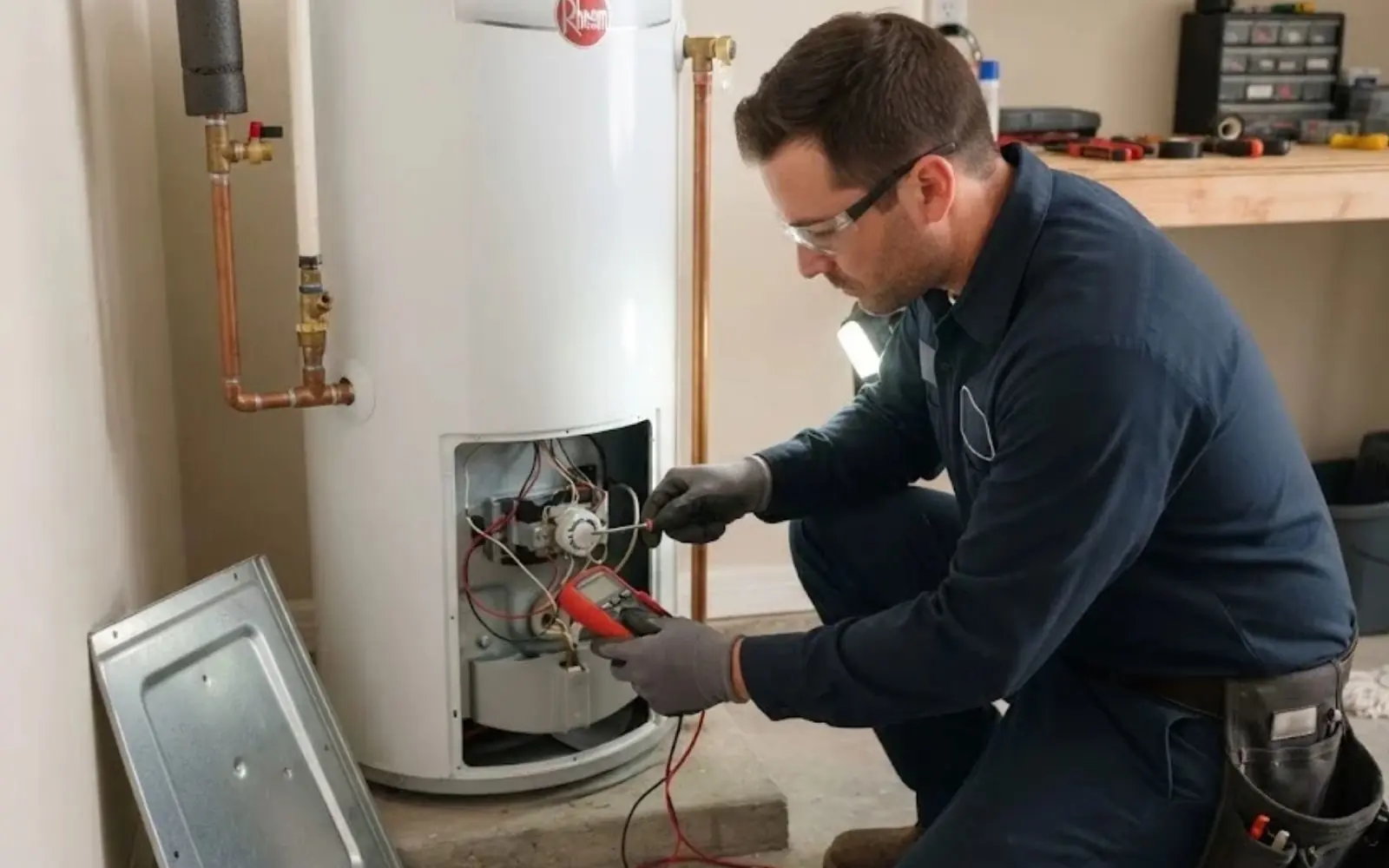
Electric tanks use two heating elements and two thermostats, upper and lower. When the lower element fails, you get a small amount of hot water and then cold. When the upper one fails, you get none. A multimeter test tells the plumber which part is open, and the repair is usually an element swap with the tank drained first. Limescale on the elements shortens their life.
Hybrid heat pump heaters add a compressor, a fan, an air filter and a condensate drain to an electric tank. Common faults are a clogged filter, a blocked condensate line, or an error code that forces backup resistance heat. They need clearance and a warm room. Compressor failures usually mean a warranty claim or a replacement. Households that want a different kind of unit can read about the tankless water heater option.
Symptom, likely cause and what gets checked.
Use this as a map of how a diagnosis usually goes. The exact answer depends on the unit in front of the plumber.
| What you see | Likely cause | What the plumber checks | Usual fix path. |
|---|---|---|---|
| Water at the base of the tank | Drain valve seep or corroded shell | Where the first drop forms, tank bottom, drain valve | Valve swap if the shell is dry, replacement if the shell is wet. |
| Drip at the top connections | Loose union, worn flex line or failed nipple | Each fitting, with the supply shut | Tighten or replace the connector. |
| Relief valve discharging | High water pressure, thermal expansion or a worn valve | Static pressure, thermostat setting, expansion control | Pressure fix or new valve, never a capped line. |
| No hot water, gas unit | Pilot out, bad thermocouple, gas control fault | Pilot flame, thermocouple voltage, venting | Part replacement, then a combustion and vent check. |
| No hot water, electric unit | Tripped limit switch, failed element or thermostat | Power at the terminals and element resistance | Reset, element or thermostat swap. |
| Rumbling or popping | Sediment layer on the tank bottom | Drain sample, tank age, element condition | Flush now or plan a replacement. |
| Error code on a heat pump unit | Filter, condensate, sensor or compressor fault | Code lookup, airflow, condensate path | Cleaning, sensor swap, or a warranty claim. |
A brown or reddish drain sample from an old tank is a warning that the steel is wearing. It does not always mean failure today, but it affects the repair-or-replace conversation.
What decides the cost of a water heater repair.
The total depends on the part, the labor and the unit's age, so a fair number comes only after someone looks at it. These are the factors that move it.
The failed part
A relief valve, thermocouple or flex connector is a small part. A gas control valve, an electric element set or a heat pump component costs more to supply and install.
Tank age and condition
A repair on an old tank can be money spent on a heater that fails somewhere else next month. The plumber should tell you honestly if the shell is the weak point.
Fuel type and venting
Gas units need a vent and combustion check after the work. Heat pump units need clearance, a condensate drain and an electrical check.
Access and location
A tank in an open utility room is quick. A tank behind a finished wall, in an attic or in a crawl space takes longer.
Timing
Night, weekend and holiday visits are billed differently from a scheduled weekday appointment. Ask how the visit is billed when you call.
Sudden and accidental water damage, such as a tank that bursts and floods a room, is typically covered by homeowners policies. The heater itself usually is not when it fails from age, and gradual leaks and wear are typically excluded. Check your own policy and take photos before cleanup.
You should hear a clear price before work starts. For a real number on your unit, call (385) 488-1892 and describe the symptom, the fuel type and the approximate age of the tank.
Orem water, older houses and the heaters that serve them.
Orem grew from about 8,000 people in 1950 to more than 52,000 by 1980, so a large share of the city's houses went up in one stretch of decades. Many still have original supply piping and drain stacks, and the water heater is often the second or third unit in that utility room. Ask the plumber to check the shutoff valves and connectors while the tank is open, because those parts age with the building.
The city's 2022 water conservation plan says Orem draws from deep wells, city springs and Provo River water, with surface water averaging about 62 percent over ten years. Because the mix changes, water chemistry can differ by season and by neighborhood, and mineral buildup on elements and tank bottoms can differ with it. Ask the technician what the drain sample looked like, since that tells you more about your own tank than any city-wide average.
Orem also bills culinary water on a tiered, increasing rate structure. A leak that runs for weeks adds to your monthly use, and heavier use is billed at higher tiers, so catching a weeping fitting early saves water as well as drywall.
Neighboring households in Provo face the same repair questions, though Provo's older neighborhoods date to well before Orem's postwar growth and often have even older plumbing around the heater.
Water Heater Repair questions from Orem homeowners
Yes. Dispatch runs 24/7, including holidays, and same-day appointments are offered when the schedule allows. Tell the dispatcher whether the unit is gas, electric or heat pump, and whether water is actively running.
The most common sources are a seeping drain valve, a failed element gasket, or a corroded tank shell. A plumber can usually separate the three by checking where the first drop forms. If the shell is the source, the heater needs to be replaced and not patched.
Not for long. The valve opens when pressure or temperature goes too high, so a valve that drips regularly is reporting a real problem. Never cap or plug the discharge line. Call and have the pressure and thermostat setting checked.
If the tank is dry and the failed part is small, repair is usually reasonable. Many homes in Orem were built between the 1950s and 1980s, and those utility rooms often hold a tank that has been replaced once already. If the heater is also near the end of its typical lifespan and leaking from the shell, replacement is the better use of money.
On an electric unit, look at the breaker and the red reset button behind the access panel. On a gas unit, see whether the pilot is lit. Do not relight a pilot if you smell gas. Leave the building and call the gas utility or 911.
Yes. These hybrid units have a compressor, a fan and a condensate drain, so air filter cleaning and a clear drain line matter. Error codes often have simple causes, but compressor faults are a different class of repair and may fall under the manufacturer's warranty.
Permit rules vary by job, so ask the Orem Building Safety Division. The city has adopted the 2021 International Plumbing Code (IPC) with Utah amendments, and a like-for-like part swap is a different matter from replacing the whole unit.
Sources and references
- City of Orem Water Conservation Plan, October 2022, conservewater.utah.gov (water source mix, tiered rates).
- U.S. Decennial Census figures (Orem population 1950 and 1980).
- City of Orem adopted codes list, orem.org (2021 IPC with Utah amendments).