
Published by Orem 24/7 Plumbing, a dispatch service in Orem, UT. Page published October 23, 2026.
A leak that is soaking drywall, pooling in a crawlspace or spinning a meter dial cannot wait for business hours, and dispatch for it runs 24/7. While you wait for a plumber, shut the main valve where the line enters the house, then open the lowest faucet to drain the pipes. Leak detection in Orem, UT means locating the exact point where a supply or drain line is losing water, before anyone opens a wall or digs a trench.
Most calls start with a clue instead of a puddle: a bill that jumped, a meter that creeps with every tap closed, a warm patch on a floor, a ceiling stain shaped like a map. This page explains how plumbers narrow those clues down, what each type of hidden leak looks like in Orem homes, and when to stop poking and call. It does not cover clogged drains or sewer backups, which are a different kind of job.
Rising water bill, damp spots and no visible pipe: how hidden leaks show up.
Hidden leaks announce themselves sideways. Watch for a bill higher than the season explains, the sound of running water when every fixture is off, a musty smell in a closet or cabinet, paint that bubbles, flooring that cups, or a warm strip on the floor above a hot line. One clue proves little. Two or three together usually point at a specific part of the house.
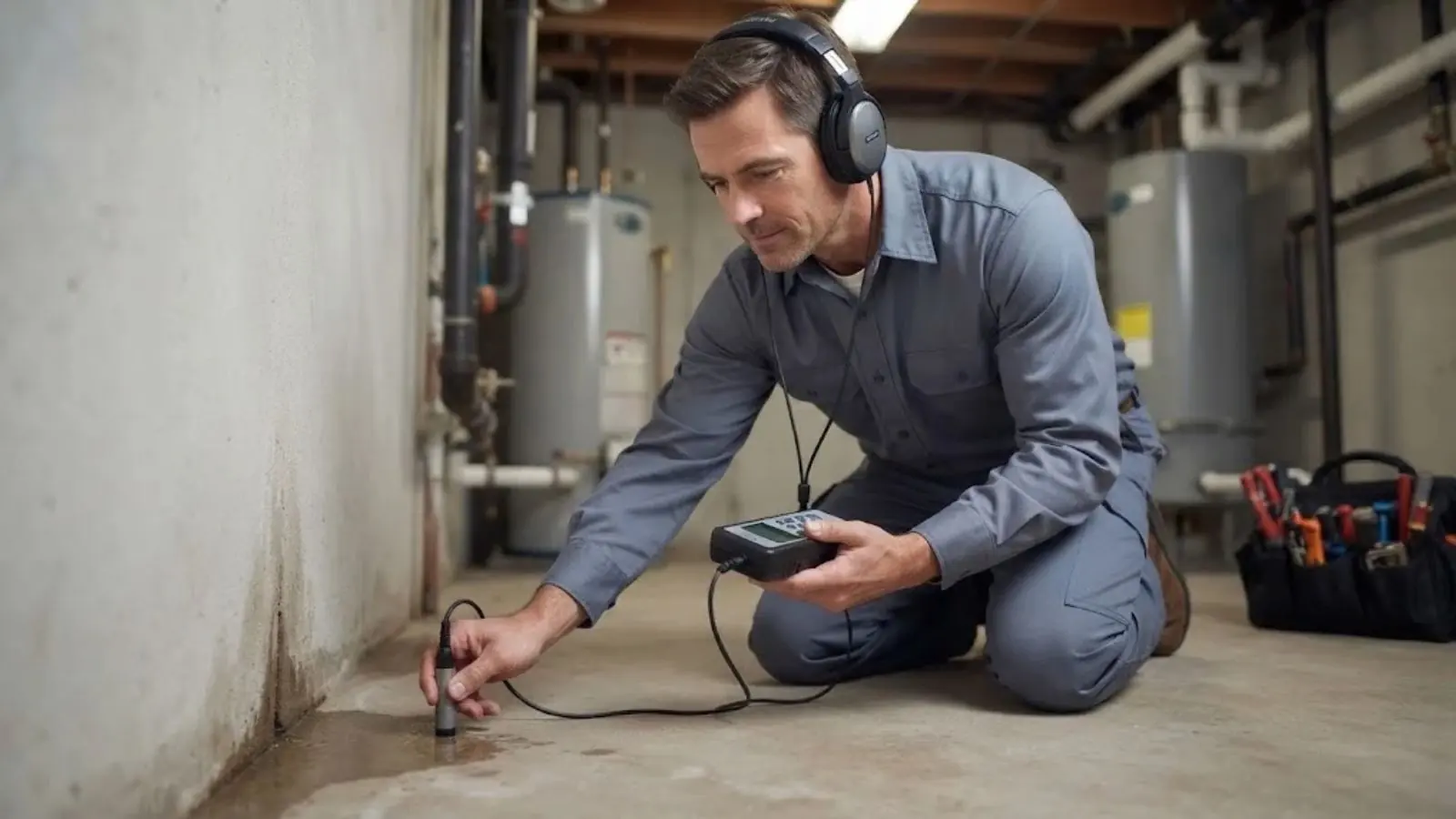
Plumbers call the next step leak detection: a structured search using pressure testing, acoustic listening, thermal imaging, tracer gas and pipe locators to find the exact spot. The aim is a small, targeted opening instead of a torn-up room. Ask which method the technician will bring when you call, because the right tool changes depending on whether the pipe sits under a slab, inside a wall or out in the yard.
Finding a leak and fixing it are separate steps and sometimes separate visits. Detection tells you where the water is going and how bad it is. Repair then runs from a single fitting swap to rerouting a whole line, and it can only be priced honestly once the location is known.
Active leak right now: what to do first.
Close the main shutoff by turning a wheel handle clockwise until it stops. A lever handle on a ball valve closes with a quarter turn so that the lever sits across the pipe. In many homes it sits near the water heater, in a utility room or in a meter box near the street. Then open the lowest faucet or hose bib to bleed off what is left in the pipes.
Keep people and pets away from wet areas near outlets, power strips and the electrical panel. Switch power off at the breaker panel only when the floor around it is dry and you can get there without stepping through water. If water is dripping through a light fixture, leave that room alone.
Move rugs and furniture off wet floors, photograph the damage for your insurer, and call (385) 488-1892. Dispatch is 24/7, nights and weekends included, with same-day appointments when available.
Symptom, likely location and how the search narrows it.
Each symptom points to a zone of the plumbing system, and each zone has its own search method. This table shows the logic a technician follows, not a diagnosis of your house.
| What you notice | Where it usually is | How the search works | What repair looks like. |
|---|---|---|---|
| Meter dial moves with every fixture off | Anywhere on the pressurized side: buried line, under a slab, inside a wall | Isolate zones with shutoff valves, then pressure test each zone | Fix the failed fitting or pipe section once the zone is proven. |
| Warm patch on a floor, hot water running low | Hot water line under the slab | Acoustic listening on the slab, line tracing, thermal imaging | Small slab opening for a spot repair, or reroute overhead. |
| Ceiling or wall stain that keeps growing | Supply line, drain connection or upstairs fixture | Moisture meter mapping, thermal imaging, fixture-by-fixture runs | Access patch, then new fitting or pipe section. |
| Hissing at the meter box, soggy strip of lawn | Water service line or meter connection | Ground microphone, pipe locator, then confirm ownership before digging | Excavate after the 811 call and replace the failed run. |
| Musty crawlspace, rusty hangers, damp joists | Supply line, drain joint or shower pan underside | Direct inspection, dye test on drains, pressure test on supply | Replace the joint, hanger or pan connection. |
| One sprinkler zone soggy, low pressure at the heads | Irrigation riser, valve or lateral line | Run and test each zone with the meter watched | Replace the cracked fitting, valve or head. |
A symptom can fit more than one row. That is why pressure tests and meter checks come before any cutting.
Meter turning with everything shut off? Call (385) 488-1892 and describe what the dial is doing so dispatch can plan the right search.
Call (385) 488-1892Water meter and high bill checks: the one-hour test.
Start at the meter. Shut off every fixture, the ice maker and the sprinkler controller, then find the leak indicator on the meter register, a small triangle or dial that turns when any water passes. If it moves, water is leaving your system somewhere. Write down the register reading, wait an hour without using water, and read it again.
Next, close the main valve at the house. If the meter stops, the loss is inside the home. If it keeps turning, the leak is on the buried line between the meter and the house, and ownership of that stretch should be confirmed with the Orem Water Division before anyone digs.
Orem's own system adds context. The city's 2022 water conservation plan describes a Leak Detection Program that uses audio and visual indicators and says older residential meters were being replaced with automated metering. That helps the utility spot unusual flow at the meter, but it cannot tell you which pipe in your house is failing. Orem also uses a tiered rate structure adopted in 2016, so extra unnoticed flow is billed at higher tiers as usage climbs.
Owners of duplexes, rentals and apartment buildings have one more question: does each unit have its own submeter, or does one meter feed the whole building? A building meter that runs with every unit's fixtures closed needs the same shutoff test, riser by riser or floor by floor. Property managers can call (385) 488-1892 with the layout and the suspected zone so the visit is planned around tenant access.
Ceiling stains and wall leaks: tracing water back to its source.
Water travels. A brown ring on a ceiling is often not under the leak at all, because water follows joists, pipe sleeves and drywall edges before it shows itself. An upstairs bathroom, a refrigerator line, a failing shower valve or a loose drain connection can all leave the same stain.
A plumber usually starts with a moisture meter, which reads dampness behind surfaces without cutting. Thermal imaging then shows cooler, wetter areas, and a pressure test on the supply lines tells whether the source is pressurized water or a drain that only leaks when used. Running fixtures one at a time lets the technician match the stain to the fixture.
Once the source is known, the opening can be a hand-sized patch of drywall instead of a whole wall. The repair is typically a new fitting, a replaced section of copper, PEX or CPVC, or a resealed shower pan. Drying the cavity matters as much as the fix, since wet insulation and drywall can grow mold if sealed up. Drywall finishing and mold cleanup are other trades, and this page covers locating and repairing the plumbing only.
Slab leaks and crawlspace leaks: what sits below the floor.
A slab leak is a break in a line that runs through or beneath a concrete foundation slab. Typical signs are a warm spot on the floor, the sound of running water at night, a meter that spins with the house shut down, and a sudden loss of hot water pressure. Hot lines are frequent suspects because copper expands and contracts against the concrete.
Locating one is acoustic work. A technician listens along the slab with sensitive ground microphones, traces the pipe path with a line locator, and may add thermal imaging to see a warm trail. The opening is then cut over one spot. From there the options are a spot repair, rerouting the line through walls or the attic, or replacing the affected run, and each choice trades cost against disruption.
Crawlspaces and raised foundations are easier. A plumber can look straight at supply lines, drain joints, hangers and the underside of a shower pan, then use dye on suspect drains or a pressure test on supply runs. Damp soil, rust on fasteners and white mineral crust on masonry are the signs. Keep in mind that water in a lower level is not always a pipe leak, since a failing sump pump can be the real cause.
Buyers and sellers sometimes order leak detection during a sale, especially on older houses or after an inspection flagged stains. A plumber can pressure test the supply lines and report on suspect zones. The result is a snapshot of that day, not a promise about the future, so ask when you call whether the visit fits your closing timeline.
Buried lines, sprinklers and pools: leaks you can only read in the yard.
The water service line runs from the meter to the house, buried below the 30 inch frost line that Orem lists in its design criteria. Leaks there rarely break the surface at first. Clues include a soggy lawn strip in dry weather, a greener patch, a sunken spot, hissing at the meter box, and a meter that runs while the house is off.
Digging out and replacing a failed buried run falls under water service line repair, including who to call before any excavation.
Sprinkler leaks hide in plain sight. Orem's 2022 water conservation plan states that the city has no secondary pressurized irrigation system, so a lawn sprinkler runs on treated culinary water. A cracked riser, a stuck valve diaphragm or a broken head can waste that water for weeks without leaving a puddle. Testing each zone alone with the meter watched finds the bad one fast.
Pools and spas lose water to evaporation, so a bucket test comes first. If the pool drops faster than a bucket set on a step, the return and suction lines become suspects. Shell cracks and liner failures belong to pool contractors.
Any excavation needs a call to Blue Stakes of Utah at 811, with advance notice (bluestakes.org lists the current minimum). Facility operators mark the lines they own, which may not include your private water or sewer line, so a private pipe locator is often used on the homeowner's side of the meter.
Before you call: document the leak so the visit starts with answers.
Ten minutes of notes saves a technician an hour of questions. None of these steps require tools.
- Read the meter register with all fixtures off, write down the number and the time, and read it again after an hour.
- Close the main valve and note whether the meter still moves, since that splits inside leaks from buried ones.
- List which rooms, fixtures or sprinkler zones show symptoms and roughly when each started.
- Photograph stains, outline their edges in pencil, and date them so growth is easy to see.
- Gather your last three water bills to compare usage against the same months last year.
- Check the toilet flapper, the water heater base and the irrigation controller for obvious causes.
- Move belongings off wet floors and keep everyone clear of wet outlets and the panel.
- Have your insurance policy handy in case the damage needs a claim number.
Why age, soil and groundwater matter for leaks in Orem homes.
Orem grew from under 10,000 residents in 1950 to more than 52,000 by 1980, so a large share of its housing went up in a roughly 30 year window. Original supply and drain lines in those homes can now be decades old. Age alone does not mean a leak, but it is a good reason to test lines instead of assuming they are fine.
The city's Water Main and Galvanized Service Line Replacement Program tells us galvanized service lines exist in Orem's system, and the plan says mains in corrosive soils are replaced more often. That does not reveal what your own line is made of. A plumber can identify the pipe material at the meter box or where it enters the house, and that answer shapes repair versus replacement.
Orem sits in a low valley near Utah Lake. Utah Geological Survey guidance warns that shallow groundwater, usually within 10 feet of the surface in low-lying valley areas, can harm buried utility lines. It adds that standard homeowners insurance does not cover groundwater flooding. A wet basement after a wet season is therefore not always a pipe leak, and a plumber will pressure test the pipes first to rule one in or out.
A line that freezes and splits is a different job. Shallow runs, hose bibs and pipes in unheated crawlspaces can freeze even with a 30 inch frost line outside, and once the break is located it becomes burst pipe repair.
What drives the cost of finding and fixing a leak.
Leak work does not come in one size, and a number quoted before anyone knows where the water is going is a guess. These are the real factors that move the total.
Location of the leak
An exposed line in a crawlspace is quick to reach. A line under a slab or beneath a driveway needs more search time and more opening and closing.
Search method required
A meter check and pressure test may settle it. Slab and buried leaks can call for acoustic listening, tracer gas and thermal imaging together.
Number of zones to test
Bigger homes, more bathrooms and separate irrigation circuits mean more zones to isolate and pressure test.
Access and surface repair
Cutting a small drywall patch differs from opening concrete or a lawn. Finish work like paint, flooring and landscaping is usually a separate trade.
The repair itself
A fitting swap, a pipe section, a reroute and a replaced run each carry different labor and materials, and some jobs need a permit.
Homeowners policies typically cover sudden and accidental damage, such as a supply line that fails and floods a room, and typically do not cover gradual leaks, wear or groundwater flooding. Some policies treat the cost of finding the leak differently from the damage it caused. Check your own policy or ask your agent before work starts.
Detection and repair can be priced separately, because the repair depends on what the search finds. You get a clear price before work starts. Call (385) 488-1892 to describe your symptoms and get a real number for your situation.
Leak Detection questions from Orem homeowners
Yes. Dispatch is 24/7, so a leak that starts at midnight or on a holiday weekend still reaches a licensed, insured plumber, with same-day appointments when available. Close the main valve first, then call (385) 488-1892.
If the water is off and nothing is actively damaging the home, the search may be scheduled for a quieter time, which also helps acoustic listening.
Check the meter with every fixture off. If the leak indicator turns or the register changes over an hour, water is escaping. Other clues are a bill that does not match your habits, warm floor spots, the sound of running water at night, and stains or musty smells that return after cleaning.
It can split the two. Close the main valve at the house and watch the meter. A stopped meter means the loss is inside, and a moving one means the buried line before the house is leaking. Confirm line ownership with the Orem Water Division before any digging.
Usually the search is done from the surface with ground microphones, a line locator and thermal imaging, so the concrete is opened only at the confirmed spot. A camera cannot see through a slab, and no instrument is perfect on every pipe, so ask which method the technician will bring when you call.
The city's 2022 water conservation plan describes the program as a utility tool using audio and visual indicators, and we cannot speak for its scope. Ask the Orem Water Division what it covers. Pipes inside your home and on your private property are normally found by a plumber you call.
Policies differ. They typically cover sudden and accidental water damage and typically exclude gradual leaks, wear and groundwater flooding. Some pay for the cost of tearing out to reach a covered leak and some do not, so read your policy or ask your agent before the work starts.
Plumbers can pressure test sprinkler laterals and pool return and suction lines. Orem has no secondary irrigation system according to the city's 2022 plan, so sprinkler water is treated culinary water and a leak shows up on your bill. Shell cracks and liner failures need a pool contractor. Dispatch also covers Provo, UT, where older housing makes hidden leaks more likely.
Sources and references
- City of Orem Water Conservation Plan, October 2022, conservewater.utah.gov (Leak Detection Program, AMI meter replacement, no secondary system, tiered rates, galvanized service line program).
- Utah Geological Survey Public Information Series 105 (2023), Shallow Groundwater Hazard in Utah, geology.utah.gov.
- Blue Stakes of Utah excavators guide, bluestakes.org.
- Orem design criteria frost line depth of 30 inches, orem.org.
- Decennial census counts for Orem as tabulated on Wikipedia.