Published by Orem 24/7 Plumbing, a dispatch service in Orem, UT. Page published October 23, 2026.
A sewer camera inspection in Orem, UT is a look inside the lateral that carries waste from your house to the city main, using a small waterproof camera on a flexible rod. The recording shows cracks, roots, offset joints, low spots and buildup, and a locator at the surface marks where the line runs and how deep it sits. It is planned work, so most visits are scheduled, and same-day appointments are available when the calendar allows.
Call (385) 488-1892 if you want to know what is in the line before you pay for a repair, before you close on a house, or after a cleaning that did not hold.
Sewer smell or slow drains, but nothing is actually backed up.
Many people call about a vague problem. A faint sewer odor in the basement, a toilet that burps after the washer drains, or a drain that is slow every few weeks, with no flood and no mess. These are the warning signs that a camera is built for.
Smell with no visible backup has several causes. A floor drain or rarely used sink may have a dry P-trap, the curved pipe that holds a water seal against sewer gas. Running water into it for a minute fixes that. A cracked or blocked vent, or a lateral with a small leak or a belly where waste sits, needs a closer look.
That is where a sewer camera inspection comes in. It turns a guess into a recording, so you can decide whether the answer is a simple cleaning, a repair, or nothing at all.
Signs that a camera look is worth scheduling.
No single sign proves a problem, but together they make a case.
- Drains that slow down again within a few weeks of being cleared.
- Gurgling toilets or bubbling floor drains when a washer or tub empties.
- Sewer odor in the basement, crawlspace or yard that does not trace to a dry trap.
- Soft, sunken or unusually green patches of lawn along the path of the lateral.
- A house that is 40 or more years old with mature trees near the sewer path.
- A purchase in progress where the seller cannot provide recent line records.
- A previous cable that stopped at the same distance every time.
What the camera can show and what it cannot.
A camera is a strong tool with real limits. This table sets out both sides.
| What you want to know | What the camera shows | Limits to expect. |
|---|---|---|
| Are roots in the pipe? | Root masses at joints, usually clearly visible | Cannot tell how deep roots have penetrated the soil. |
| Is the pipe cracked or broken? | Cracks, missing sections, offset joints | Hairline cracks may be hard to see in dirty pipe. |
| Is there a belly? | Standing water in a low section | Needs a clean line to read the slope. |
| Where does the line run? | Locator signal at the surface gives depth and path | Accuracy drops near metal, wiring or deep pipe. |
| Is the line safe to buy? | A recorded view of the lateral | Does not cover under-slab drains or interior vent pipes. |
A camera cannot see through standing water or heavy debris, so a line may need a short sewer line cleaning pass before the picture is clear.
If a drain keeps slowing down, call to schedule a camera look and see the pipe before you spend on a fix.
Call (385) 488-1892Orem's older laterals and Utah County soils.
More than six times as many people lived in Orem in 1980 as in 1950, and the houses built in that window are now four to seven decades old. If a home was built then and the sewer lateral was never inspected, a camera look is one of the cheaper ways to learn its condition.
Orem is in a low valley near Utah Lake, and Utah Geological Survey guidance puts shallow groundwater generally within 10 feet of the surface in such areas. Wet soil can shift a buried line, which is one more reason to look before buying. Newer homes in Vineyard, also served by dispatch, usually have younger lines, but a camera still confirms the builder's work.
How the inspection and the locate work.
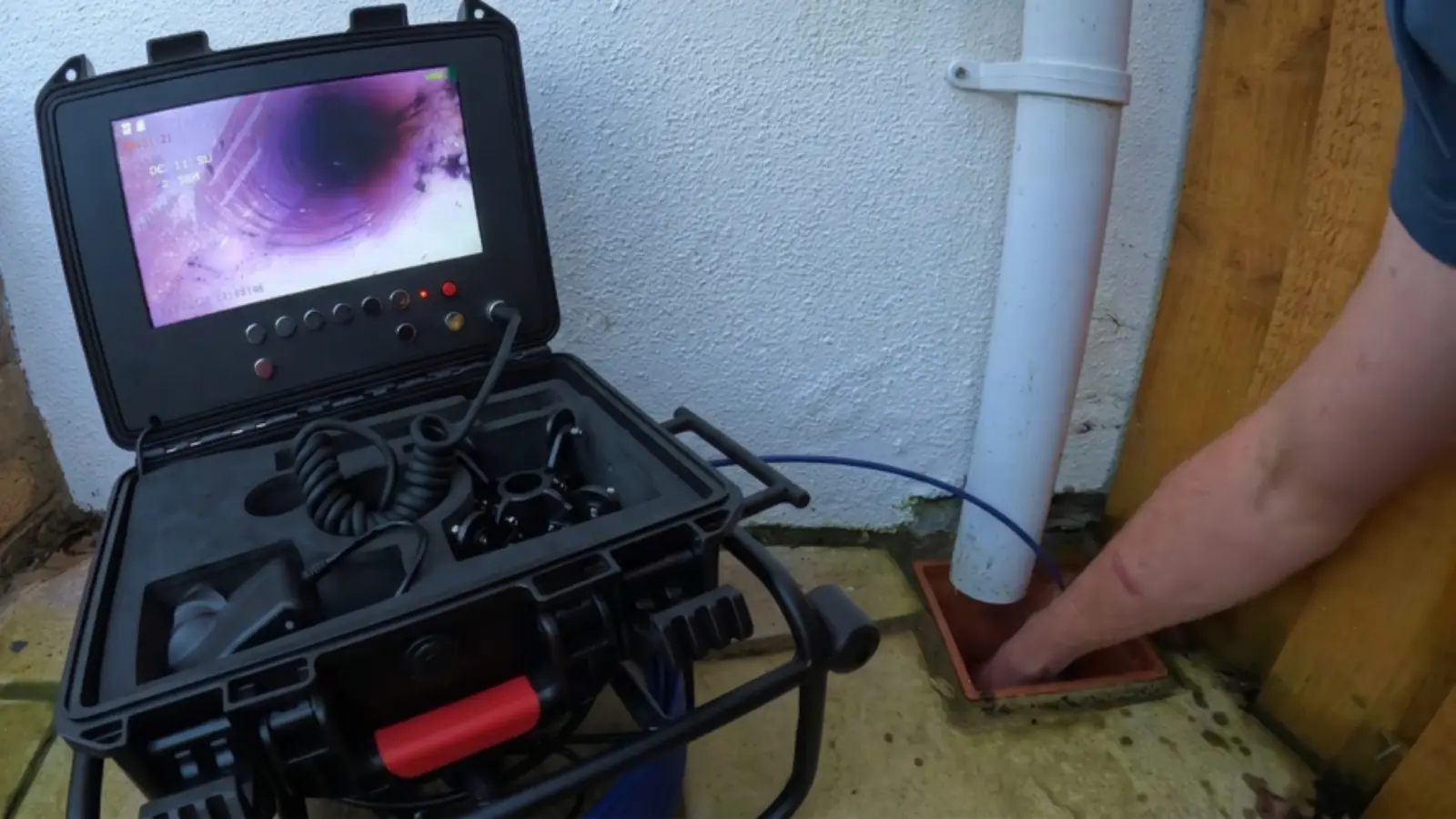
The plumber feeds the camera head through the cleanout, a capped pipe that gives access to the lateral. The head carries lights and sends live video to a monitor and a recorder. A counter tracks how far the camera has gone, so findings are tied to a distance.
A transmitter in the camera head, called a sonde, sends a signal to a handheld receiver at the surface. The plumber follows that signal to mark the pipe path and depth on the lawn or slab. That mark matters for any later repair, because it tells the crew where to dig and what lies above.
After the run, you can ask to see the video and hear the plumber explain each finding. If damage shows up, the next step is a repair plan, which the sewer line repair page explains. If roots or grease show up in a sound pipe, hydro jetting may clean it.
What affects the price of a sewer camera inspection.
Inspections are priced by the work, and the visit is quoted before it starts.
Access to the line
A cleanout makes the run easy. If the plumber must pull a toilet to get in, labor grows.
Length of the lateral
A short run to a nearby main is quick. A long or deep run takes more time and cable.
Need for cleaning first
A line full of grease or scale must be cleaned before the camera can see the wall.
Locating and marking
Tracing the path and depth at the surface adds time but helps any future repair.
Report and recording
A copy of the video and a plain summary help in a home purchase or an insurance discussion.
Insurers generally pay for sudden, accidental loss, and they generally exclude wear, root damage and groundwater flooding. A pre-purchase inspection is usually paid by the buyer. Check your own policy if a camera finds damage that has already caused a loss.
Because the price depends on access and length, a short call is the quickest way to get a real number. Call (385) 488-1892 and describe your situation.
What this inspection does not cover.
A sewer camera inspection looks at the pipe. It does not fix a break, replace a section or clear a blockage by itself. It also does not assess the foundation, the roof drains, a septic tank or the storm drain system, which are separate trades.
The camera cannot see through standing water, and it can miss a hairline crack in dirty pipe. If a lateral has a belly full of water, the picture will be incomplete. A fair plumber will say so and suggest a cleaning pass before a second look.
Sewer Camera Inspection questions from Orem homeowners
It is a sensible step, especially for houses built before 1990. Many Orem homes date from the 1950 to 1980 growth, so original laterals are now decades old. A recording gives you facts to use in negotiations.
It can find a cracked or belled section, a belly or a root-filled joint. If the smell comes from a dry trap or a vent problem, the camera will show a clean line and the plumber will check the trap and vent instead.
A sonde in the camera head sends a signal that a handheld receiver picks up at the surface, giving the path and depth. Blue Stakes of Utah at 811 marks public utilities before any dig, but it may not mark your private lateral.
A camera inspection normally does not, but permit rules vary by job. Plumbing is governed by the 2021 International Plumbing Code (IPC) as adopted by Orem, so ask the Orem Building Safety Division if a repair follows.
Sometimes. Water seeping through a joint or a belly holding water can be visible. Utah Geological Survey guidance says shallow groundwater can damage buried utility lines in low areas like this valley.
Sources and references
- Utah Geological Survey Public Information Series 105 (2023), geology.utah.gov.
- Orem adopted codes list, orem.org (2021 IPC with Utah amendments).
- Blue Stakes of Utah excavators guide, bluestakes.org.
- U.S. Decennial Census counts as tabulated on Wikipedia.