Published by Orem 24/7 Plumbing, a dispatch service in Orem, UT. Page published October 23, 2026.
A failed water line can flood a yard or leave a house with no water, so dispatch for it runs 24/7. If water is surfacing outside, shut the valve where the line enters the house and keep children and pets off soft ground. Water service line repair in Orem, UT is the work of locating, exposing and replacing the buried pipe that carries water from the meter to your home.
This page is about the private-side run, which is a different trade from interior pipe work. It explains the symptoms, who owns which stretch, how crews dig or avoid digging, and what the options cost in practical terms. It does not cover street mains, which belong to the city.
Soggy lawn, weak pressure or a climbing bill: when the buried line is the problem.
Many homeowners first notice a symptom, not a pipe. A wet patch in a dry week, a sudden drop in pressure at every fixture, or a meter that runs with the house shut down all point toward the line between the meter and the foundation. The technical name for the repair is water service line repair, and it starts by proving the leak is on that stretch.
Orem's housing growth explains why this matters. The city grew from about 8,000 people in 1950 to more than 52,000 in 1980, so some service lines may be decades old.
The city also runs a Water Main and Galvanized Service Line Replacement Program, which means galvanized lines exist in the system and are replaced over time. That does not tell you what your line is made of, so a plumber should identify the material when the line is exposed.
Orem's design criteria list a frost line depth of 30 inches, so buried lines are meant to sit below it. A line that is shallower or crosses a driveway edge sees more movement and temperature swing. The city's 2022 water conservation plan also describes a Leak Detection Program, and Orem has been replacing older meters, so a meter alert may be the first sign of a problem.
Low water pressure, no water and meter clues: reading what the line is telling you.
Low pressure is the most common complaint that leads to a service line call, and it has more than one cause. A pressure drop at one faucet is usually a fixture problem. A drop at every tap points upstream.
| Symptom | What it suggests | What a plumber checks. |
|---|---|---|
| Low pressure at every fixture | Restriction or leak on the service line, a partly closed valve or a failing pressure regulator. The code limit for static pressure at a fixture is 80 psi, so ask for a gauge reading | Static pressure at a hose bib, valve positions, meter readings. |
| Low pressure at one faucet only | Clogged aerator or a failing fixture valve, not the buried line | Aerator, cartridge and shutoff valve at that fixture. |
| No water at the house | Closed or failed valve, frozen or broken line, or a utility outage | Main valve, meter box, neighbors' service, visible line damage. |
| Meter dial runs with all fixtures off | Leak on the buried line or inside the house | Close the house valve and see whether the meter stops. |
| Hissing or wet ground at the meter box | Leak at the meter connection or the first section of line | Ownership of the connection, listening, locating the line. |
| Green or sunken strip across the lawn | Slow leak along the buried pipe path | Pipe locator, ground microphone, then a test dig after 811. |
If the neighbors have no water either, the cause may be the street main or an outage and the Orem Water Division is the right call before a plumber.
What to check before you assume the buried line has failed.
Five minutes with a flashlight rules out cheaper causes and gives the dispatcher better information.
- Confirm the main valve at the house is fully open. A quarter-closed handle can mimic a leak.
- Look at the meter box lid. Standing water, bubbling or a wet gasket marks a leak near the connection. Do not force the lid with a tool.
- Run a hose bib and note whether pressure is weak outside as well as in the kitchen.
- Listen near the house wall where the line enters. A steady hiss with fixtures off is a clue.
- Walk the straight path from meter to house and look for the greenest, wettest or sunken strip.
- Check whether neighbors also have low pressure or no water.
- Write down the meter reading, shut the house valve and read again after a short wait.
Wet yard or no water at the house? Call (385) 488-1892 and describe it so dispatch can plan the dig and the 811 call.
Call (385) 488-1892How a water service line gets located and repaired.
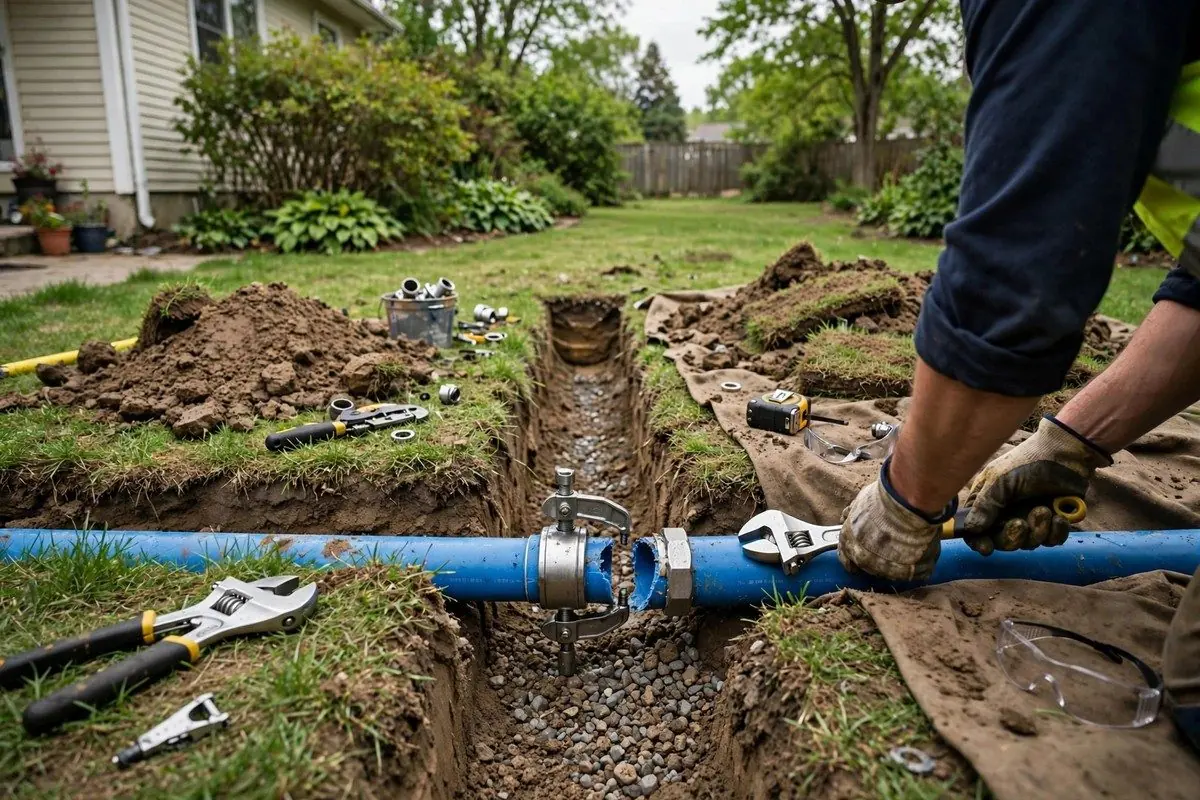
The work starts above ground. A technician confirms the leak is on the buried stretch, then uses a line locator and, for a pressurized leak, a ground microphone to find the spot. Marking the pipe path matters because a trench should be a few feet long, not a lawn-wide gash.
Digging starts with a call to Blue Stakes of Utah at 811. The notice must be advance notice (bluestakes.org lists the current minimum) and can be placed no more than 14 calendar days ahead. The markings cover utility-owned lines only, and a private water or sewer line may be absent from them, so a private locator often fills the gap.
Once the pipe is exposed, the crew cuts out the failed section and joins in new pipe, or replaces the whole run if the pipe is corroded or the damage spreads. The line is pressure tested before backfill. Ask when you call what materials the technician plans to use, since the choice affects durability and cost.
A line that has split because of a freeze, or a house that has several failing fixtures and valves, may also involve burst pipe repair inside the walls. The two jobs are often done together.
Water line emergency: shut it off first and settle ownership before digging.
If water is surfacing in the yard or a driveway is washing out, close the valve where the line enters the house. Ask the Orem Water Division whether you may operate the valve in the meter box, since it is part of the utility's equipment.
A leaking line can undermine soil near a foundation or a walkway. Keep people clear of sunken or soft ground and do not dig yourself. Digging without an 811 call risks striking a gas, power or communications line.
Ownership is the limit of this page. The street main and the meter equipment are the utility's side, and the point where responsibility passes to the homeowner must be confirmed with the Orem Water Division before work. Emergency calls get 24/7 dispatch, including nights and weekends, and same-day appointments are offered when available.
What shapes the cost of a water line repair.
Prices vary more here than for most plumbing jobs because the pipe is buried and the surface above it differs from house to house.
Length and depth of the run
A long line or one below the frost line takes more digging, more pipe and more backfill.
Surface above the pipe
Lawn, gravel, concrete and pavers each change the work. Restoring a driveway or sidewalk is often a separate trade.
Pipe material
Copper, plastic and other materials have different material costs and different joining methods.
Spot repair or full replacement
One clean leak on sound pipe is smaller than replacing a corroded line from meter to foundation.
Utility coordination
Ownership questions, locate delays and any city involvement affect how long the job takes.
Standard homeowners coverage tends to respond to sudden, accidental damage and tends to exclude wear, gradual leaks and groundwater flooding. Whether a buried line is covered at all depends on the policy, so check yours before work starts.
A clear price is given before work starts, after the line is located and the surface is understood. Call (385) 488-1892 to describe what you see and get a real number.
Repair, replace or go trenchless: the honest trade-offs.
A spot repair is the least disruptive when the pipe is otherwise healthy. It fixes one failure and leaves the rest. If the line is old steel or has leaked before, expect the next failure nearby and weigh replacement.
Full replacement buries a new line along the old path or a straighter one. It costs more up front and takes longer, but it removes a known weak run and can restore pressure lost to buildup inside old pipe. This is the usual answer when the line is corroded along its length.
Trenchless methods pull or burst a new pipe through the old path with small entry pits instead of a long trench. They protect landscaping and concrete but need the old line to be accessible and suitable, and not every site qualifies. Ask the technician whether your line, depth and soil allow it.
If the problem looks like it may be inside the house instead, a search with leak detection separates interior from buried leaks first. Long term, a run with repeated problems may be better solved by repiping the interior as well. Crews from Orem also serve Lindon, where the same 811 and ownership questions apply.
Water Line Repair questions from Orem homeowners
Yes. Dispatch is 24/7, nights and weekends included, with same-day appointments when available. Close the house valve, keep people off soft ground, and call (385) 488-1892. Digging itself may wait for the 811 locate, but the water can be controlled right away.
Look for a wet or sunken strip between the meter and the house, a meter that moves with every fixture off, a hissing sound near the entry, and pressure that fell at every tap. If the meter stops when you close the house valve, the leak is inside. If it keeps moving, suspect the buried line.
Low pressure at every fixture points upstream. Suspects include a partly closed main, a failing pressure regulator, a restricted or leaking service line, or a utility problem. The code limit for static pressure at a fixture is 80 psi, so ask for a gauge reading. Low pressure at one faucet is usually that fixture. Check whether neighbors have the same issue before you call.
The street main, the meter and the private run may not share one owner. The Orem Water Division can tell you where the city's responsibility ends. Confirm that before digging so you know who pays for which part.
Yes. Excavators in Utah must give Blue Stakes advance notice (bluestakes.org lists the current minimum). Markings may leave out your private lines, so a private locator is often used as well.
Sometimes. Trenchless methods use small entry pits instead of a long trench, but they require the old pipe to be suitable and reachable. A spot repair still needs one opening. Ask which approach fits your line when you call.
The city's 2022 water conservation plan describes a Water Main and Galvanized Service Line Replacement Program. It says galvanized lines exist in the system and are replaced over time, but it does not tell you whether yours is on the list. Ask the Orem Water Division.
Sources and references
- City of Orem Water Conservation Plan, October 2022, conservewater.utah.gov (Leak Detection Program, meter replacement, galvanized service line program).
- Blue Stakes of Utah excavators guide, bluestakes.org.
- Orem design criteria frost line depth of 30 inches, orem.org.
- Decennial census counts for Orem as tabulated on Wikipedia.