
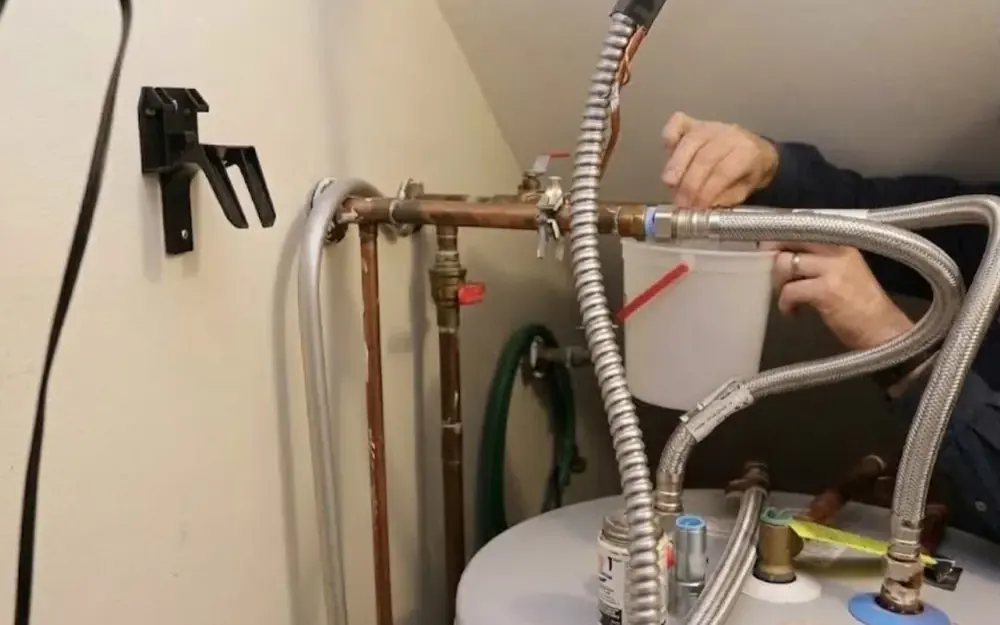
A water heater hose is the short flexible connector that links your shutoff valves to the tank. These connectors are often the first thing to fail on an otherwise healthy heater, and a slow weep at the crimp can soak a garage floor or closet for days before anyone notices.
If a hose is spraying or the floor around the tank is wet right now, close the cold water shutoff valve on the line above the heater and call right away. Dispatch runs 24/7. Keep people and pets out of the wet area, and leave the gas controls of a gas heater alone.
What the two hoses actually do.
Every storage tank has a cold inlet and a hot outlet on top. Between each port and the house piping sits a flexible connector, usually a braided stainless sleeve over a rubber or plastic liner, with a threaded nut on each end. The flex lets the tank be set down slightly off line with the pipes and lets it move a little as it heats and cools.
A gas heater has a third line, the gas connector, which is a different part with different rules. Treat that one as plumber-only work. A hose swap on the water side is a separate job and does not involve the gas control valve at all.
Signs a hose is near the end of its life.
Most failures give a warning. Look with a flashlight and a dry paper towel, because a seep that evaporates leaves only a faint ring.
- White or green crust on the nut or the crimped ferrule, which means water has been escaping slowly.
- Rust-colored stains or broken wire strands in the braided sleeve.
- A hose that is kinked, stretched tight, or bent sharply right at the fitting.
- A damp paper towel after you wipe the underside of each connection and wait ten minutes.
- Water stains on the floor or on the tank jacket directly below the inlet and outlet.
- Hoses that were installed with the heater and have never been looked at since.
Orem, UT: why older homes and local water matter here
Orem's population grew from 8,351 in 1950 to 52,399 in 1980, so much of the housing stock is four to seven decades old. In practice that means many water heater closets still have original shutoff valves, and an old valve that will not close is the most common reason a simple hose job becomes a bigger one. Test your valves by turning them gently once a year.
The city's 2022 water conservation plan says Orem's culinary water comes from deep wells, city springs, and Provo River water treated at a regional plant, with the mix varying by season and by location in the city. Because the chemistry can shift, the sensible habit is to look at the connections at the tank every few months rather than trusting a calendar.
For permits, Orem's published adopted code is the 2021 International Plumbing Code (IPC) with Utah amendments, and permit rules there vary by job, so ask the Orem Building Safety Division whether a connector swap alone needs one.
What you see and what it usually means.
Use this as a quick sort before you pick up a wrench. It is a decision aid, not a diagnosis, because a leak at the top of the tank can come from more than one part.
| What you see | Likely source | Sensible next step. |
|---|---|---|
| Drip at the nut where the hose meets the pipe | Loose or worn fitting, or a failing washer inside the nut | Shut the valve, check the washer, and replace the hose if the seat is damaged. |
| Weeping at the crimped end of the braid | Hose body failing at the ferrule | Replace the hose, never tighten the nut harder to stop it. |
| Crust or rust where the hose screws into the tank | Corroded tank port or nipple | Stop and call, because the tank itself may be leaking. |
| Water running down the tank jacket from the top | Either port, the relief valve, or the tank | Find the exact wet spot before buying parts. |
| Wet floor with a dry-looking top | Tank bottom or drain valve | Treat as a failing tank and plan a replacement. |
The third and fifth rows are the ones that surprise people. A new hose on a corroded port only moves the leak a few inches.
If your connectors look crusty or wet, call and describe what you see before you buy parts.
Call (385) 488-1892.How a hose swap works on an electric or gas storage tank.
This is the general sequence for a straightforward replacement on a tank with working shutoff valves. Skip it if the valves do not close fully or the fittings are corroded.
Cut the energy
Turn an electric heater off at its breaker, or set a gas heater control to pilot or off. Never leave an electric element powered with the tank drained.
Close the cold supply and relieve pressure
Shut the cold valve, then open a hot faucet in the house so the tank can take in air and the lines stop pushing.
Unscrew and set the old hoses aside
Have a bucket under each connection. A little water will come out of the connector itself.
Fit new connectors
Use new rated connectors of the same thread size and a length that makes a gentle curve, not a tight bend. Replace the washers instead of reusing them.
Refill and check
Open the cold valve with the hot faucet still open until it runs steady, then close the faucet and check each joint with a dry towel for several minutes.
Choosing the right replacement connector.
Match the connector to the job in three ways: the thread size at each end, the length, and the rating on the label. Take the old hose to the store or photograph the stamped markings. A connector rated for potable water and for hot water is the only kind that belongs here, so check that the label says potable and hot water rated, and do not substitute a washing machine hose.
Many installers also fit dielectric unions or nipples where copper meets the steel tank port. Dissimilar metals corrode at the joint, and that corrosion is a common reason a fresh hose starts weeping within a season. If your tank ports already look chalky, price the work as a heater repair visit instead of a ten-minute swap. Homeowners in Provo, American Fork and other nearby towns can describe the same symptoms when they call.
When a hose job turns into a heater decision.
A hose problem sometimes exposes a bigger one. If the shutoff valve will not close, the pipe behind it is corroded, or the leak traces back to the tank body, the cheap fix is gone. Tank walls cannot be patched, and a tank that is leaking from its shell is finished.
That is the point to compare a water heater repair visit against a full replacement and ask the plumber which one the symptoms support. Bring up the tank's age and where the water first appeared. A hose that failed on a young tank is just a hose, and an old tank with a rusted port is a different conversation.
What drives the cost of a hose replacement.
The part itself is a small line item. The total changes with whether the shutoff valves still work, whether the ports need new dielectric fittings, how hard the tank is to reach, and whether the visit happens after hours. A planned weekday swap and a night call for a spraying connector are billed differently, and a clear price before work starts is the best way to compare them.
When you compare two quotes, ask each plumber to separate parts, labor, any trip or after-hours charge, and anything they would do beyond the hose. If one quote quietly includes a new shutoff valve and the other does not, they are not the same job.
Common questions
There is no single interval, because it depends on the connector and the water. Look at both hoses a few times a year and replace one at the first crust, rust, or kink, and whenever you replace the heater.
It is better not to. Old connectors have already flexed, and their washers are compressed. New connectors cost little next to the job of fixing a flooded closet.
A steady drip is urgent, and a spray is an emergency. Close the cold shutoff above the heater and call right away. Same-day appointments are available when possible, and dispatch runs 24/7, including nights and weekends.
Orem's water comes from wells, springs, and treated Provo River water, so the chemistry can differ by season and neighborhood. No page can promise a rate of wear for your house. The reliable test is a flashlight and a dry towel on a schedule.
The city publishes an annual water quality report, which is a better starting point than guesswork if you suspect scale or corrosion at your connections.
Orem's permit rules vary by job, so ask the Orem Building Safety Division before you start. Replacing the heater itself is a different job, so ask the Division about that separately.
Sources and references
- Census counts for Orem 1950 and 1980 (U.S. Decennial Census as tabulated on Wikipedia).
- City of Orem Water Conservation Plan, October 2022, conservewater.utah.gov.
- City of Orem adopted codes list (2021 IPC with Utah amendments) and Building Safety Division permit page, orem.org.