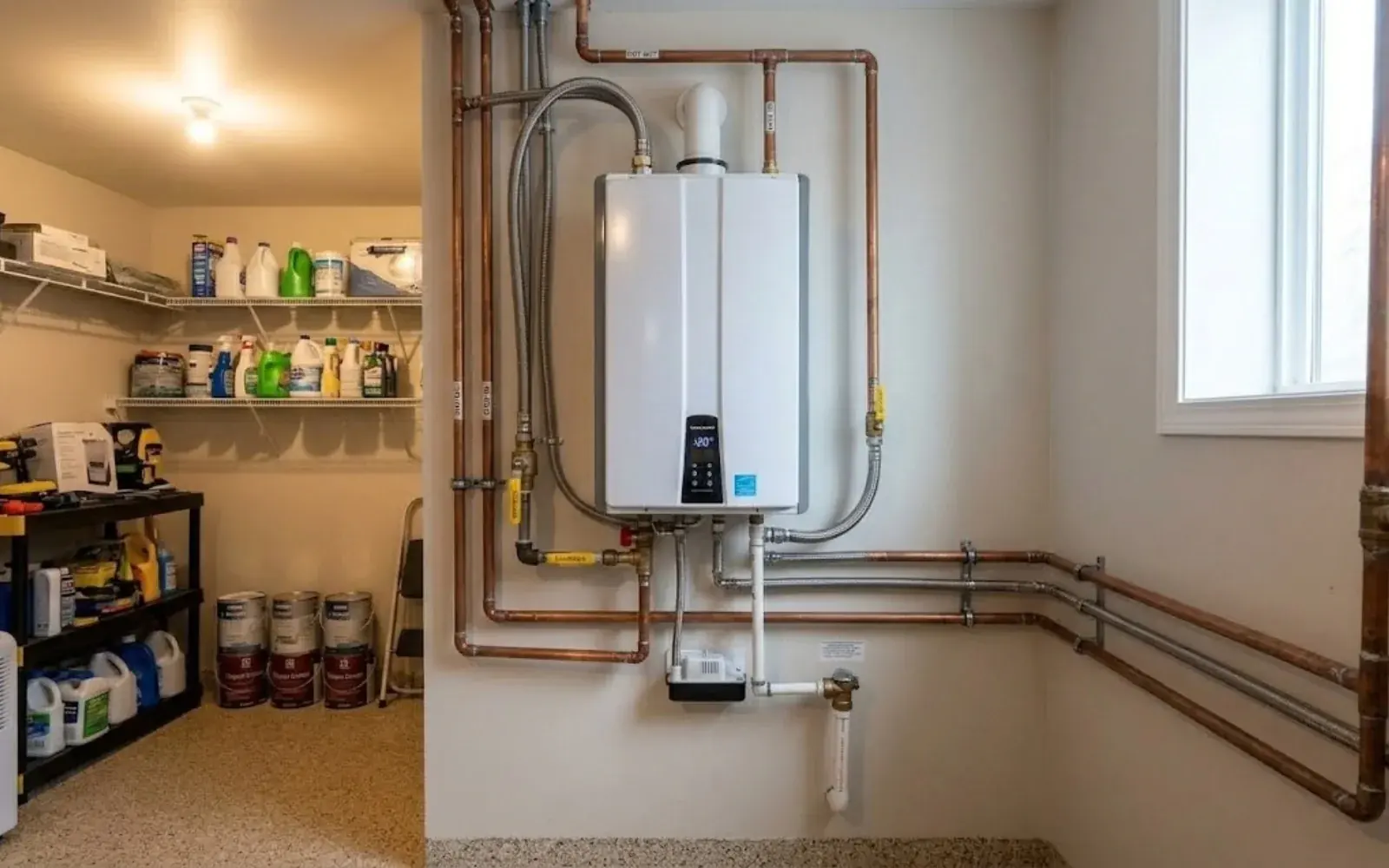
A whole house tankless heater has no storage tank. When a hot tap opens, a flow sensor fires a burner or energizes heating elements, and water is heated as it passes through a heat exchanger. The upside is hot water that does not run out mid-shower. The trade-off: it can only heat so much water per minute, and the install asks more of your gas line, vent or panel than a tank does.
This post covers how to decide, what the install touches in a typical Orem house, and what ongoing care looks like. It gives no prices, since a real number depends on your vent path, fuel supply and fixtures.
How a tankless unit differs from a 40 gallon tank.
A tank keeps a fixed volume hot all day and runs out when you pull more than that volume in a short window. A tankless unit has no such limit on duration, but it has a ceiling on flow, measured in gallons per minute at a given temperature rise. Run a shower, a dishwasher and a washing machine at once and the unit may not keep up.
Because there is no standing water to buffer demand, the unit also needs a minimum flow to switch on. A trickle from a faucet can leave the water cool or cause it to cycle between warm and cold. Ask the technician how the unit you are considering behaves at low flow.
Gas or electric: what each one asks of the house.
The fuel choice sets most of the installation work. Use this as a conversation starter, not a substitute for the manufacturer's installation manual.
| Type | What the house must supply | Common sticking point. |
|---|---|---|
| Gas tankless | Adequate gas line size, a sealed vent path to the outdoors, a condensate drain on condensing models | The existing gas line or old flue may be too small or the wrong type. |
| Electric tankless | A large dedicated electrical load on its own circuit | The panel may lack spare capacity and a licensed electrician must check it. |
| Gas tank, for comparison | Existing vent and gas connection often reused | Runs out of hot water in long or overlapping use. |
| Electric tank, for comparison | A dedicated circuit already in place | Slow recovery after a heavy draw. |
Read the nameplate on the unit you plan to install and share it with both your plumber and, for electric, a licensed electrician. Panel capacity is a judgment for the electrician, not something to guess.
Orem, UT: what the city's plan and codes mean for a tankless project
Orem's 2022 water conservation plan describes a system fed by wells, springs and Provo River water, and notes that the sources vary. A heat exchanger sees whatever the tap delivers, so the mix at your address affects scale. Read the annual water quality report and ask the installer to include service valves so a flush is simple.
The city's adopted codes list names the 2021 International Plumbing Code (IPC) with Utah amendments, and permits run through the Orem Building Safety Division, which says permit rules vary by job. For a project that adds a gas line, vent or electrical circuit, call the Division before booking a date so you know what inspections to expect.
Sizing starts with your busiest hour.
List the fixtures that could run at the same time in your busiest hour: showers, kitchen sink, dishwasher, washer. Each fixture has a rated flow, usually printed on the fixture or its box. The sum, plus the temperature rise needed from your incoming water to your set temperature, tells the technician what capacity to look for.
Incoming water is colder in winter, so a unit sized for summer may disappoint in January. Size for the cold months, and ask whether one unit or two smaller ones suit a larger house. The tankless water heater service page explains how those questions are worked through on a typical call.
The arithmetic is simple enough to sanity-check a quote. Heat needed in BTU per hour is roughly flow in gallons per minute times temperature rise in degrees Fahrenheit times 500. As an illustration, 5 gallons per minute with a 70 degree rise needs about 175,000 BTU per hour delivered to the water, before efficiency losses. Use the manufacturer's tables for the real figure.
Want to talk through fuel, venting and sizing for your house? Call and describe your fixtures to a licensed plumber.
Call (385) 488-1892.Scale, flushing and the service question.
Heating water in a narrow heat exchanger encourages mineral scale, and scale cuts efficiency and can trigger error codes. Most manufacturers call for periodic descaling, often by circulating a mild descaling solution through the unit using isolation valves. Ask whether the install includes those service valves, because without them a flush is much harder.
How fast scale builds depends on your water, not on the brand. Do not trust a hardness figure you read online for your street. Check the water quality report from your utility and run a simple test at your own tap, then let that guide how often you schedule service.
Questions to settle before you buy.
Bring these to any plumber you call so quotes line up.
- Which fuel will it use, and what changes in the house to support it?
- Where will it vent, and does the vent route need new pipe through a wall or roof?
- Are isolation valves for flushing included in the install?
- How many fixtures can run together at your winter incoming temperature?
- Does the unit need a condensate drain, and where does that drain go?
- Who handles the permit, and has the building department been asked about your specific job?
Planning the install and checking neighbors' towns.
A tankless project is a planned install, so it follows the same steps as any other heater project. The water heater installation page covers permit questions and gas safety. If you smell gas at any time, leave the building and call the gas utility or 911 before anything else.
The questions above apply the same way in nearby towns. A homeowner in Pleasant Grove or American Fork weighing a whole house unit will face the same vent, fuel and flow decisions, though each city handles permits on its own terms.
Common questions
It heats continuously, but only up to its flow rating. Too many fixtures at once can exceed that rating and the water cools.
Sometimes. Gas units need a proper vent path and gas line, and electric units need a large circuit. The plumber will check the closet, vent and supply before confirming.
Most manufacturers call for periodic descaling, and the right interval depends on your water. Follow the installation manual and ask your plumber about a schedule.
It can be. Many Orem homes date from the post-war growth decades, so panels may be older and tight on space. Have a licensed electrician check the panel before committing to an electric unit.
Policies typically cover sudden and accidental damage and typically do not cover wear or gradual leaks. Check your own policy for how it treats appliance failure.
Sources and references
- City of Orem Water Conservation Plan, October 2022 (Utah Division of Water Resources), https://conservewater.utah.gov.
- City of Orem adopted codes list, as of July 1, 2023, https://www.orem.org (2021 International Plumbing Code with Utah amendments).
- City of Orem Building Safety Division permit page, https://www.orem.org.
- Utah Division of Occupational and Professional Licensing license verification, https://secure.utah.gov/llv/search/index.html.
- Census growth figures for Orem (U.S. Decennial Census) as tabulated on Wikipedia, used for the housing-era statement.
- Technical statements are general trade practice and defer to the manufacturer's installation manual. Electrical and gas capacity are not quantified: the reader is told to read the unit nameplate and have a licensed electrician check the panel.