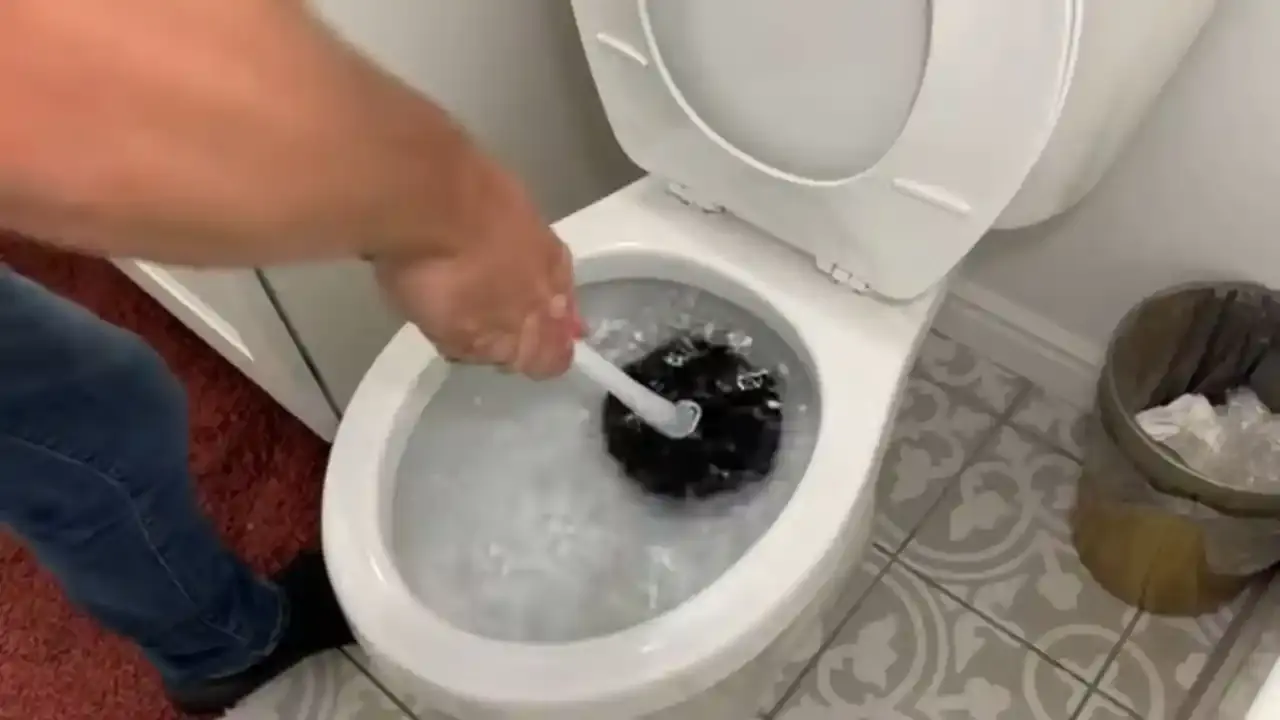
A toilet that will not flush and is rising toward the rim is a stressful sight, but it is usually a local blockage in the trap just below the bowl. Most homeowners can clear it with a plunger or a closet auger and about fifteen minutes.
If water is about to spill, lift the tank lid and push the flapper down to stop more water entering, or close the supply valve behind the toilet. If other drains are gurgling or backing up too, stop and call. Dispatch is available 24/7 for sewage that is coming back into the house.
Why a toilet clogs in the first place.
A toilet moves waste through a curved passage inside the porcelain, called the trap, and then into a drain line only a few inches wide. Anything that does not break down quickly can lodge in that curve. Heavy paper loads, so-called flushable wipes, cotton products, and small toys are the usual culprits.
A slow flush with a weak swirl points to a partial blockage or a vent problem. A bowl that fills and drains very slowly while the tank refills normally points to a stoppage further down. Knowing which one you have saves you from plunging a clog that is not in the toilet.
How to clear a stopped toilet, step by step.
Gather a flange plunger, which has a rubber collar that fits the bowl outlet, plus rubber gloves, old towels, and a bucket.
Stop the rise
Close the supply valve or lift the tank lid and hold the flapper closed. If the bowl is very full, bail some water out into a bucket first.
Seat the plunger
Fit the flange into the outlet so the cup seals fully around the opening. Add a little water if the bowl is low so the cup is covered.
Push gently, then pull hard
Do slow strokes with a firm upstroke, because the pull is what dislodges the blockage. Ten to fifteen strokes is enough to judge whether it is working.
Test with a small amount of water
Pour a half bucket into the bowl. If it drains steadily, flush once. If it rises again, stop and move to the auger.
Use a closet auger
A closet auger has a protected tip that will not scratch porcelain. Feed it through the trap, crank gently, and pull back whatever it catches.
Orem, UT: older drain lines and a water bill that rewards fixes
Orem went from 8,351 residents in 1950 to 52,399 in 1980, so most of the city's homes have drain lines that are now decades old. Older lines are more prone to roots and offsets, which is why repeat toilet clogs in an older home deserve a camera look instead of another round of plunging.
The city adopted a tiered rate structure for culinary water in 2016, with rates that increase at higher use. A toilet that keeps running after a clog, or a tank that refills in a loop, adds to total usage and can push a household into a higher tier.
To check for a silent leak, put a few drops of food coloring in the tank and wait without flushing. If color shows up in the bowl, the flapper is leaking and worth replacing promptly.
The same reasoning applies to neighbors in Pleasant Grove and Provo, where the age of the house is a better guide to drain trouble than the town name.
What a symptom tells you about where the clog sits.
Use the pattern of what is happening in the house to decide who should handle it.
| What you notice | Where the blockage likely sits | What to do. |
|---|---|---|
| One toilet is slow, nothing else is affected | In the toilet trap or its short outlet | Plunge, then use a closet auger. |
| Toilet gurgles when the shower or washer drains | Branch line or main line is partly blocked | Stop using water and call for drain service. |
| Water backs into a tub or floor drain when you flush | Main drain or sewer lateral | Do not use more water, and call for same-day help. |
| Clog returns every few weeks | Something in the line, such as roots or a belly | Ask for a camera look instead of repeated plunging. |
| Toilet rocks, leaks at its base, or has a stained floor | Failed wax seal or loose flange | Fix the seal before it rots the subfloor. |
If the plunger is not working, call and describe which fixtures are affected.
Call (385) 488-1892.What to leave alone when the bowl will not drain.
Skip chemical drain openers. They sit in a toilet bowl, do not reach the blockage, and leave a caustic pool that splashes onto your skin and onto a plumber later. A wire coat hanger scratches the porcelain and can wedge the object tighter.
Do not keep flushing to see if it clears. Each flush adds a full tank of water, and a tank holds more than a bowl can. If water reaches the rim and keeps climbing, shut the supply valve and call. Raw sewage back in the house is a health issue as well as a plumbing one.
When the clog is not really the toilet.
Several fixtures acting up at once is a different problem. A toilet on the lowest level of the house that overflows when the washer drains, or a basement floor drain that bubbles, usually means the main line is blocked. A plunger will not touch that. This is the job of a drain cleaning crew, who run a cable or a high-pressure water jet through the line.
A toilet that clogs often can also have a mechanical cause, such as a worn flush valve or a partly blocked rim jet. A plumber doing toilet repair will check the flush, the fill valve, and the seal under the bowl. If you want to replace an old toilet that never flushes well, that is also a reasonable time to ask about a new one.
If the cause turns out to be the drain line, any repair falls under the International Plumbing Code (IPC) as the city has adopted it. Permit rules vary by job, so ask the Orem Building Safety Division before the work starts.
After you clear it, check these before you relax.
- Flush three times in a row and watch the swirl, since a weak one means the clog may not be fully gone.
- Look under the bowl and around the base for water, which would suggest the seal was disturbed.
- Run the sink and shower nearest the toilet to see if they drain at a normal speed.
- Wipe and dry the floor, then check again in an hour for a slow seep.
- Remove wipes, cotton products, and paper towels from the toilet routine, and put a small bin nearby.
- Note what came out of the line, because a repeated item points to a habit and not a fault.
What affects the cost when you do call.
The price changes with where the blockage sits, whether a camera is needed, the time of day, and how hard the toilet is to remove if it has to be pulled. A short clog in the bowl is a different visit than a main line stoppage at midnight.
Ask for a clear price before work starts, and ask whether the quote covers a camera look if the clog is deep. If a plumber finds a problem that is a separate job, ask them to price it as its own line.
Common questions
A flat-cup plunger does not seal well in a toilet outlet. A flange plunger, which has an extra rubber collar, fits the opening and moves much more force into the trap.
A squirt of dish soap and warm water can lubricate a soft clog. Use warm, not boiling water, because very hot water can crack porcelain.
Call when other drains are affected, when water is coming up in a tub or floor drain, when the clog keeps returning, or when you have tried a plunger and an auger without success. Same-day appointments are available when possible, and dispatch runs 24/7.
Older drain lines can collect roots, scale, and offsets, and Orem's housing grew fast between 1950 and 1980. A repeat clog in an older home can be a line issue and not a toilet issue, and a camera look settles the question.
Orem uses a tiered rate for culinary water, with a higher rate at higher use. A running or looping tank adds to the total, so fix a leaking flapper or fill valve promptly.
Sources and references
- Census counts for Orem 1950 and 1980 (U.S. Decennial Census as tabulated on Wikipedia).
- City of Orem Water Conservation Plan, October 2022, tiered rate structure adopted 2016, conservewater.utah.gov.