A whole house water filtration system treats the water where it enters the home, so every tap, shower and appliance gets the result. That also means a neglected system affects the whole house. A clogged cartridge can drop pressure at every fixture, and a softener that has stopped regenerating can let scale build up in the water heater without anyone noticing.
This guide covers what wears out, how often to look at each part, and the signs that call for a plumber. It applies to homes in Orem, UT with a sediment filter, a carbon filter, a water softener or a combination. Follow your manufacturer's schedule over any general number here, since cartridge life depends on the model and on the water going through it.
The parts that wear out in a whole house system.
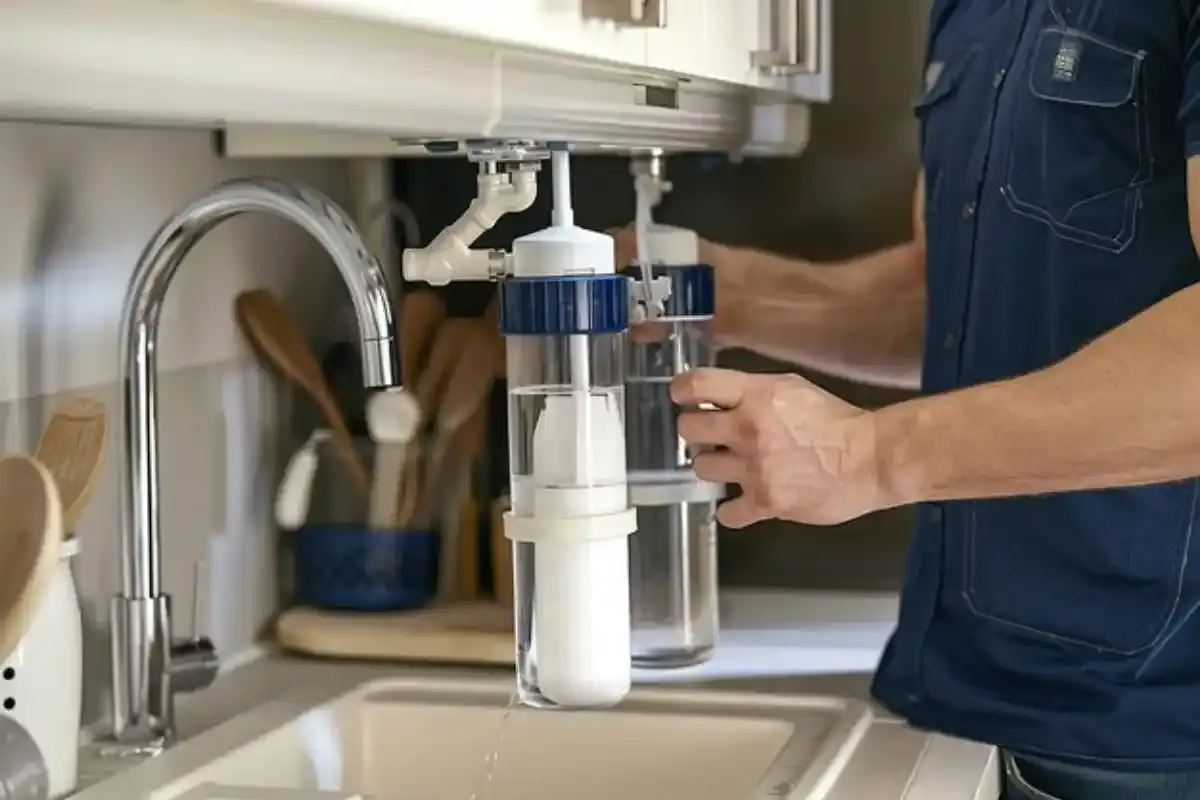
A sediment prefilter catches sand, rust flakes and silt before they reach the rest of the system. It is the part that clogs first, and a clogged one shows up as falling pressure at every tap. Many housings have a clear bowl or a pressure gauge on each side, and a gap between the two readings tells you the cartridge is loaded.
A carbon filter, usually a block or a granular tank, works on taste, odor and certain chemicals. Carbon has a finite capacity, so after it fills it stops removing what it was installed to remove. The water often tastes fine the whole time, which is why the manufacturer's replacement date matters more than your palate.
A water softener uses resin beads that trade hardness minerals for sodium or potassium and then regenerate with brine. The brine tank needs salt, the control valve needs correct settings, and the resin eventually wears out. If your system also includes a reverse osmosis unit at the kitchen sink, its filters and membrane follow their own schedule.
A routine check you can do without tools.
Spend ten minutes at the start of each season.
- Read the pressure gauges on either side of the sediment filter if the housing has them, and note the gap.
- Look at the cartridge through the clear bowl, or write down the date it was last changed.
- Lift the brine tank lid and check the salt level and whether a hard crust has formed across the top.
- Look for drips or damp spots at the housing seals, bypass valve and drain line.
- Run a hot tap and watch the flow for a drop in pressure compared with the cold side.
- Check the controller display for error codes or a regeneration schedule that looks wrong.
- Check the date stamp on every cartridge against the manufacturer's replacement interval.
Orem, UT: a mix of water sources and what it means for your system
According to the city's 2022 water conservation plan, Orem's culinary water comes from three kinds of source: nine deep wells, city-owned springs and Provo River water treated at the Don A. Christiansen Regional Water Treatment Plant.
Over a ten-year average, surface water supplied about 62 percent, wells about 28 percent and springs the remainder. Because the sources differ, water chemistry can differ by season and by where a home sits, so a filter that worked well one year may need a different schedule the next.
The same plan says Orem does not have a secondary pressurized irrigation system, so all of the city's water is treated culinary water. For a homeowner, your outdoor spigots and sprinklers draw from the same treated supply as your kitchen tap. Ask your plumber whether the outdoor lines tie in before or after the filter, since running lawn water through a cartridge shortens its life.
The EPA requires community water systems to deliver an annual consumer confidence report, and epa.gov/ccr links to each local utility's report. Read the one for Orem, then test your own tap. Together those tell you more about your water than any hardness number printed in a blog post.
Warning signs and what they usually mean.
A change in the water or the plumbing is useful information. This table links common signs to likely causes.
| What you notice | Likely cause | What to check first | Who handles it. |
|---|---|---|---|
| Lower pressure at every fixture | Loaded sediment cartridge | Pressure gauges and cartridge condition | You, or a plumber if the housing is stuck. |
| White crust on faucets or showerheads | Softener not regenerating or out of salt | Salt level, valve settings, bypass position | You first, then a plumber. |
| Salty or off taste | Regeneration cycle leaking brine, or a drain issue | Valve and drain line | Plumber. |
| Water leaking from the housing | Dried O-ring, cracked bowl or overtightened fitting | Seal and thread condition | You for the seal, plumber for a cracked bowl. |
| Hot water volume dropping | Often scale in the water heater, though sediment buildup or a heater fault can look the same | Softener operation, heater condition | Plumber. |
None of these is an emergency by itself. A housing that is spraying water is, and the main water shutoff should be closed while you call.
If your pressure has dropped at every tap, call the number on this page and describe the filter you have.
Call (385) 488-1892.Why filtration and your water heater are connected.
Scale builds where water is heated. A softener that has stopped working lets hardness minerals reach the water heater, where they form a layer on heating elements or inside a heat exchanger. A tank heater loses efficiency, and a tankless unit may start throwing error codes or need a descaling flush.
If you own an on-demand unit, ask the plumber how often to descale it given your filtration. Tankless water heater service often goes hand in hand with a filter check for exactly this reason. A cartridge that is overdue is a cheaper fix than a heat exchanger that is coated.
When to call a plumber instead of changing it yourself.
Cartridge swaps are a normal homeowner job when the housing has a shutoff and a pressure-relief button. Call a plumber when the housing will not open, the bypass valve is stuck, the softener will not regenerate or water is leaking from a fitting you cannot reach.
A good water softener and filtration service call should end with a clear list. It names the parts that were replaced, the settings that were checked, the next change dates and anything that is near the end of its life. Ask for that list, because it turns maintenance from a guess into a calendar.
Filter and softener questions come from homes across the service area, including Provo and American Fork, and the checklist above applies in any of them.
Limits: what this guide does not cover.
This guide does not tell you what is in your water or which treatment you need. A filter is chosen for a specific problem, and without a test result you are guessing.
It also does not replace a manufacturer's manual. A filter that is not independently certified for your use may not do what the label says. Look for the NSF/ANSI listing that matches the filter type, such as 42 for taste and odor, 53 for health-related contaminants and 44 for softeners. The same goes for a filter run past its rated life.
Planned filtration work is not an emergency. Same-day appointments are offered when available, but a leaking housing or a stuck bypass is the only part of this topic that cannot wait.
Common questions
Follow the manufacturer's interval, since it depends on the model and on how much sediment your water carries. Watch the pressure gauges or the cartridge color as well. A drop in flow at every tap is the practical signal.
That depends on your own tap and your own preferences. Orem's culinary water comes from wells, springs and treated Provo River water, so chemistry can vary by season and by location. Read the city's water quality report, test your tap, and then decide with a plumber.
It can contribute. Scale forms where water is heated, so a softener that has stopped working lets hardness minerals build up on heating surfaces. A water heater service visit should include a look at the softener.
If it is spraying or flooding, yes. Close the main water shutoff, keep people away from wet electrical areas and call. Orem 24/7 Plumbing dispatches around the clock for active leaks.
Federal rules require community water systems to deliver an annual consumer confidence report, and the EPA's CCR page links to local reports. You can also contact the Orem Water Division and ask where the current report is posted.
Sources and references
- City of Orem Water Conservation Plan, October 2022, conservewater.utah.gov.
- U.S. EPA Consumer Confidence Reports page, https://www.epa.gov/ccr.
- General maintenance guidance reflects manufacturer practice and was not tied to a specific product.