
Published by Orem 24/7 Plumbing, a dispatch service in Orem, UT. Page published October 23, 2026.
Plumbing installation in Orem, UT means putting new supply, drain, vent and fixture connections where none existed, or replacing what is there during a remodel or build. It is scheduled work, and the goal is a layout that passes inspection and holds up for decades.
If something is leaking or backing up right now, the repair pages are the faster route, starting with toilet repair for bowls and leaking tanks. This page is for projects you can plan, measure and permit.
What counts as a plumbing installation job.
Installation covers many tasks. Examples include a new bathroom added to a basement, a kitchen island sink, a laundry hookup, an outdoor hose bib, a water softener loop, a vanity swap and the gas line to a range or fire feature. Each one has supply lines, a drain, a vent and a shutoff.
The drain and vent are where most amateur work fails. A drain needs a steady slope, and every fixture trap needs a vent so it does not siphon dry. A fixture that gurgles or smells after install usually has a vent or trap arm fault, not a faulty fixture.
Gas line work: leave the building first.
If you smell gas, leave the building immediately and call the gas utility or 911 from outside. Do not use a light switch, a phone inside the house or anything that could spark.
For planned gas work, such as a new range line or a gas dryer, ask when you call whether a gas line job fits the visit. Gas work needs a pressure test and inspection, and many projects pair a plumber with the utility's schedule.
Rough-in, inspection and finish: how the sequence works.
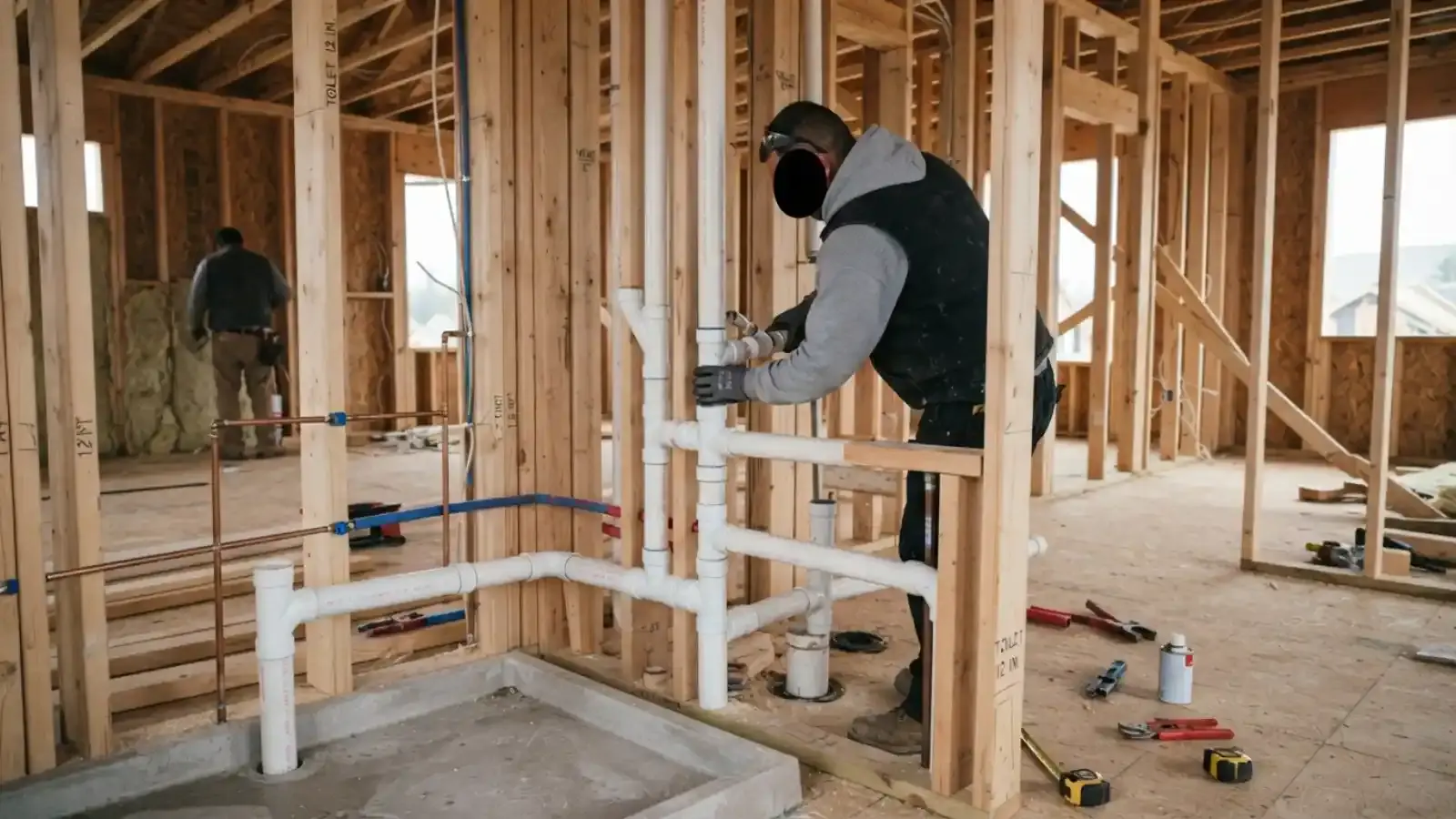
Rough-in is the first stage. Pipe, drains and vents are run through open framing or a trenched slab, then capped and pressure tested before anything is covered. The inspector looks at slope, support, venting and joints at this point, so rough-in is the moment to catch a wrong fixture location.
Finish is the second stage. Walls are closed, flooring is down, and fixtures, trim, faucets, toilets and supply stops are set. A final inspection checks that everything works. Swapping a sink in the same location is closer to finish work, and a new bathroom is both stages. A faucet swap that exposes a bad stop turns into faucet and valve repair first.
Planning a new fixture or remodel? Call (385) 488-1892 to talk through scope, permits and scheduling.
Call (385) 488-1892Installation project types and what they involve.
This table shows the main project types, what makes each one different and what needs to be settled before work starts.
| Project | Main work | Decide before scheduling. |
|---|---|---|
| Fixture swap in the same spot | Disconnect, set new fixture, test | Fixture model, rough-in dimension, stop condition. |
| New bathroom in a basement | Drain tie-in, vent, supply, possible ejector pump | Drain depth, permit, finished floor height. |
| Kitchen remodel | Move sink, dishwasher and disposal lines | Cabinet layout, vent route, gas range location. |
| Laundry hookup | Supply valves, standpipe, drain | Box location, standpipe height, floor drain. |
| Outdoor hose bib or irrigation tie-in | Frost-proof sillcock, backflow device | Wall location, shutoff, drainage. |
| New construction | Underslab, rough-in, finish | Plan set, inspections, trench depth. |
Water heater work is its own category. For that, see water heater installation, which covers sizing, venting and permits.
Code, permits and digging in Orem.
Plumbing work in Orem falls under the 2021 International Plumbing Code (IPC) with current Utah amendments, as the city's published list of adopted codes shows. The Orem Building Safety Division handles permits, and its permit page lists plumbing among the work that generally needs one. Which jobs need one varies, so ask the Division before you start.
Trenching for a new line triggers Blue Stakes of Utah (811). Excavators must give advance notice (bluestakes.org lists the current minimum) and may not request more than 14 calendar days ahead. The facility operators mark only the lines they own, which may not include your private water or sewer line, so ask the plumber how the private line will be located.
Buried exterior lines must sit below the local frost depth, and a hose bib needs to be a frost-proof type set with a slight downward slope. Ask the plumber how any outdoor tie-in will be protected.
What drives the cost of an installation.
Installation costs vary far more than repairs, so a clear price before work starts matters.
Scope and number of fixtures
One toilet is a short job. A bathroom with a shower, vanity and toilet is a project with its own rough-in.
Pipe material and routing
Copper, PEX and PVC differ in cost and labor, and a long route through finished walls takes longer.
Access and demolition
Open framing is easy. A finished wall or a slab needs opening, patching and sometimes concrete work.
Permits and inspections
Permit fees and inspection visits depend on the job and are set by the city, not the plumber.
Fixture selection
Fixtures you supply and fixtures the plumber sources are priced separately, and the quality range is wide.
Insurance does not pay for planned improvements. A homeowners policy typically covers sudden and accidental damage, so a project that goes wrong from a past leak is a separate matter. Check your own policy if you are unsure.
A call is the way to get a scoped number. Describe the project and call (385) 488-1892, and the plumber will tell you what to measure before the visit.
Prepare for an installation visit.
- Measure the rough-in distance, wall to the center of the drain, for any toilet being replaced or added.
- Choose fixtures before the visit, and keep the model numbers and installation sheets.
- Photograph the wall, floor and ceiling where the work will happen, including any existing shutoffs.
- Locate the main shutoff and confirm it closes fully before the plumber arrives.
- Ask whether a permit is needed, and who will request it.
- Clear a path to the work area, and protect finished floors.
Plumbing Installation questions from Orem homeowners
The city's permit page lists plumbing among the work that needs a permit, with exceptions listed separately. Rules vary by job, so ask the Orem Building Safety Division, or raise it when you call.
Rough-in is the pipe, drains and vents inside walls and floors, tested before they are covered. Finish is setting fixtures, faucets, toilets and trim once surfaces are complete.
Utah licenses plumbers through the Division of Occupational and Professional Licensing, and permit requirements can apply to homeowner work. Verify any plumber's license with the state's online license verification tool.
Buried lines must be set below the frost depth that the city lists in its design criteria, and Blue Stakes 811 notice applies before any digging.
It can be, but older homes often have drains below the level a basement bathroom needs, so an ejector pump may be involved. A site visit confirms depth, slope and venting.
Leave the building immediately and call the gas utility or 911 from outside. Do not turn anything on or off inside. Dispatch also covers American Fork, UT, where new construction calls for the same permit and inspection steps.
Sources and references
- Orem adopted codes list and Building Safety Division permit page, orem.org.
- Orem design criteria, frost line depth 30 inches, orem.org.
- Blue Stakes of Utah excavators guide, bluestakes.org.
- Utah DOPL license verification, secure.utah.gov/llv/search/index.html.